
Why Study the Baboons on Foot?
The Okavango Delta is a place of beauty, adventure, and danger — home to lions, leopards, hyenas, hippos, and more. In early 1977, Steve Smith, Barbara Kus, and I arrived there as students to begin a long-term study of chacma baboons (Papio ursinus), and we fully expected to observe them from the relative safety of a vehicle.
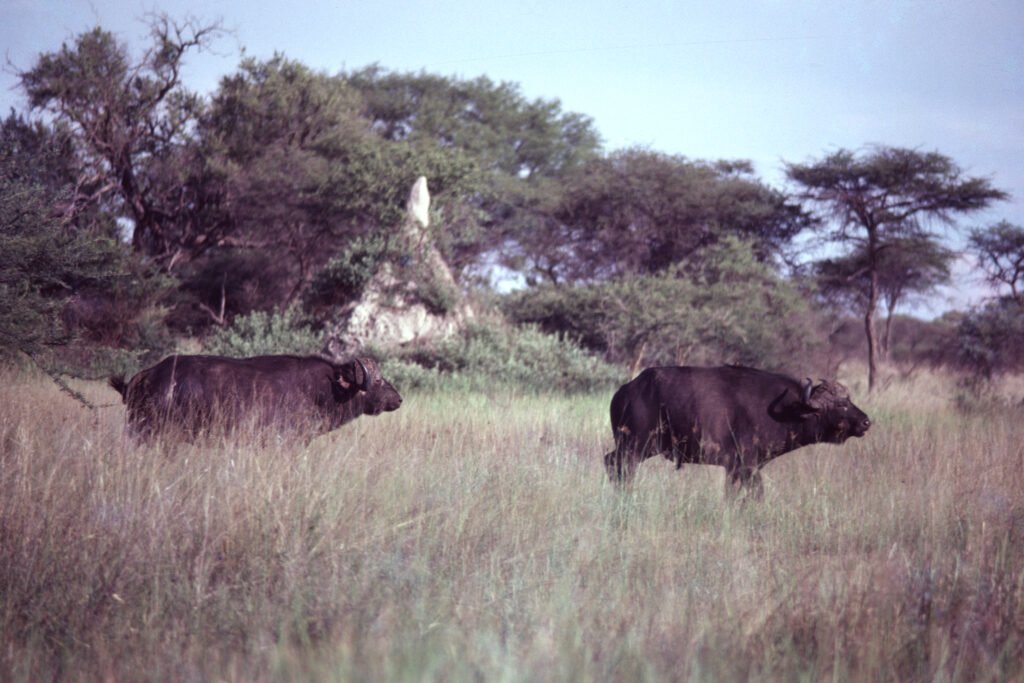
Cape buffalo were common. While herds are relatively predictable, solitary animals or small groups can be among the most dangerous in Africa. (Note the towering termite mound in the background.) 
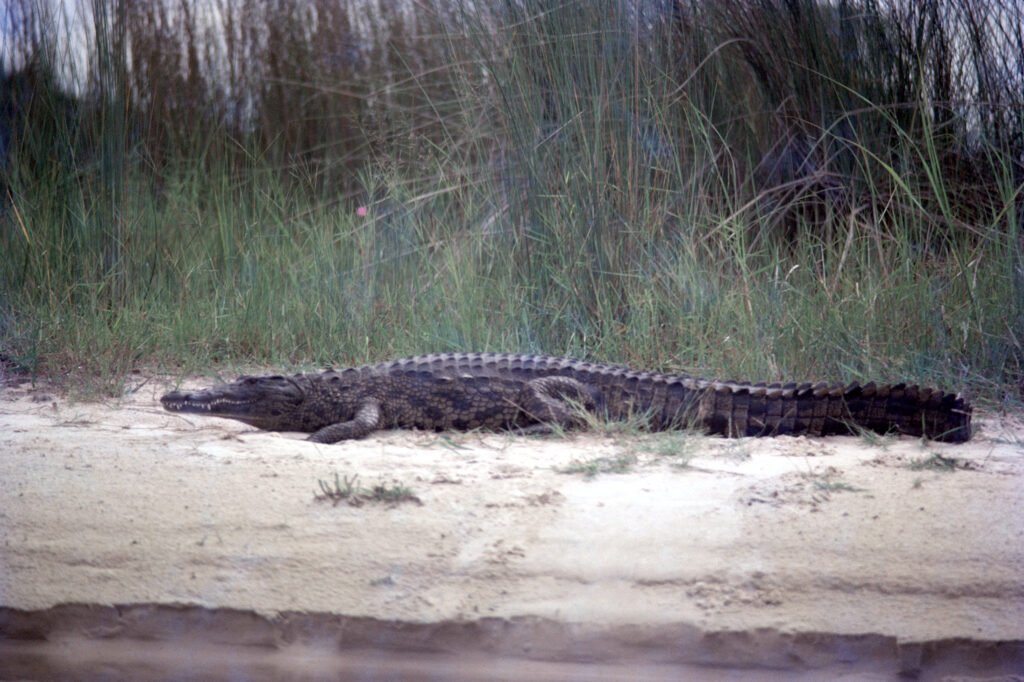
This fellow was lounging on a sand bar along the Boro River about a mile south of our camp.
Our professor at U.C. Davis, William J. “Bill” Hamilton III, had worked in the Okavango before, at a site about twelve miles from our new one. Knowing the dangers, he and his previous students had conducted all their observations from a vehicle, and Bill assumed we would do the same.
So I was tasked with buying a used Land Rover in Namibia. I drove it across the Kalahari Desert to Maun, the frontier town at the edge of the Delta. From there, we loaded the Rover and our supplies onto a barge and spent a full day chugging up the Thamalakane and Boro rivers to the new research site (dubbed “Baboon Camp”), just inside the Moremi Wildlife Reserve and near the center of the Okavango.
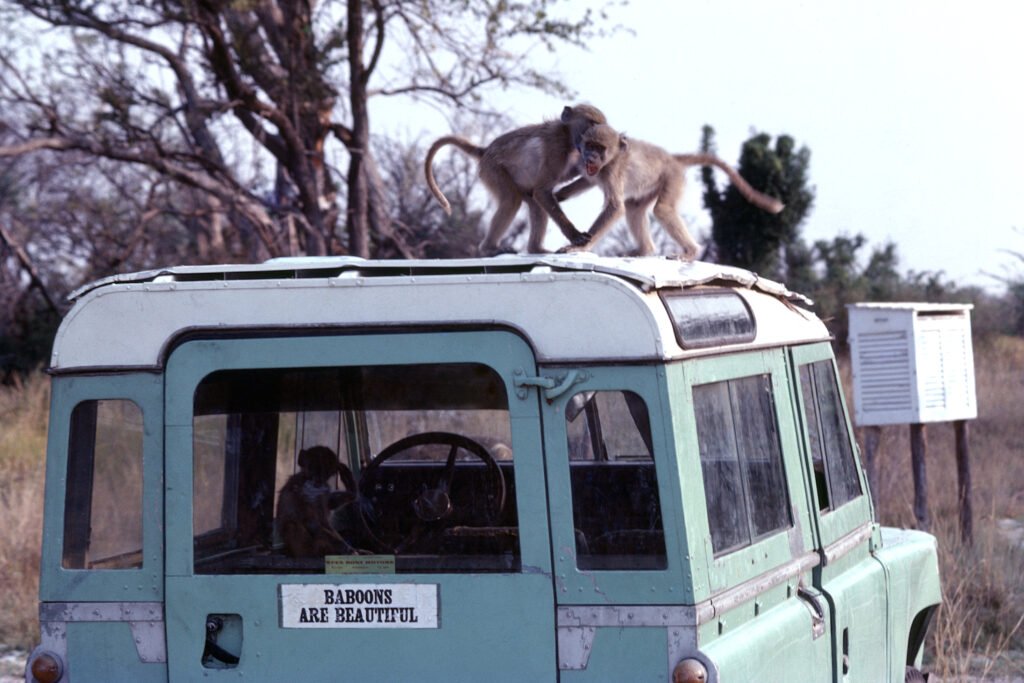
Young baboons enjoyed playing on the Rover.
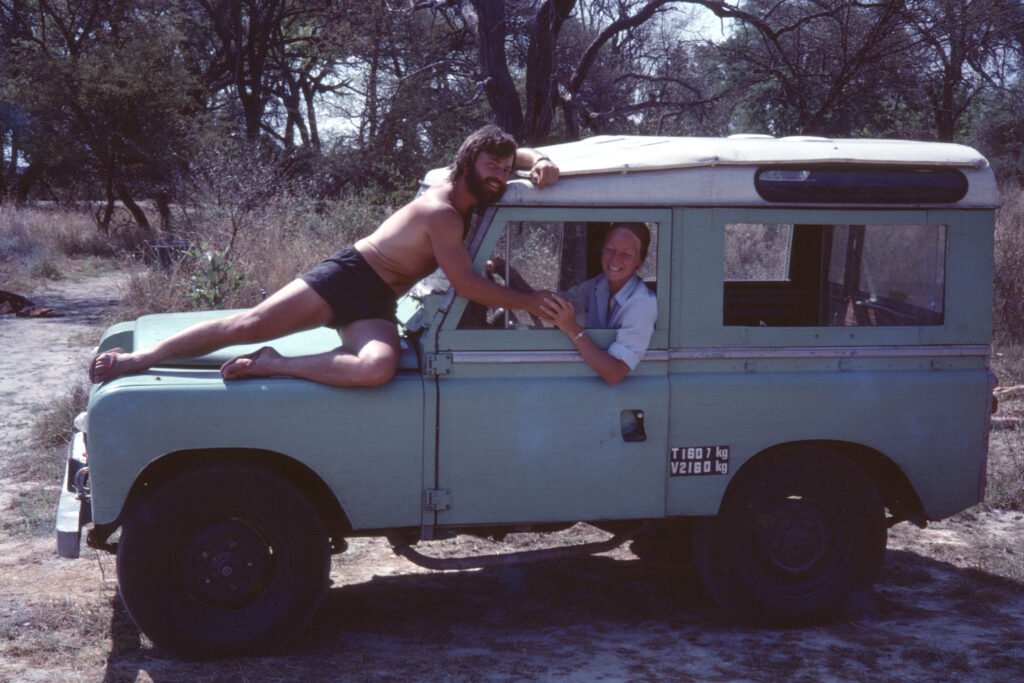
Steve and Barbara pose with our newly acquired Land Rover.
Bill coined the expression “evolutionarily relevant context” to describe an ideal field site, one minimally affected by humans and as close as possible to the habitat and conditions in which the study species evolved. For this reason, he was especially drawn to the Okavango. He even insisted that we study a baboon troop whose range did not overlap with our camp, reasoning that predators such as leopards and lions might avoid the camp area, preventing us from observing predation at natural levels. (We would eventually break this rule.)
We consulted our neighbors, P. J. and Joyce Bestelink, who had recently established the Xaxaba tourist camp1 just two miles down the Boro river. They suggested we search for baboons on White Island — the largest island nearby — which, they assured us, supported abundant wildlife, including its fair share of predators. The floodwaters were high at the time, and P. J. mapped out a circuitous route that minimized deep water crossings (see map, here).
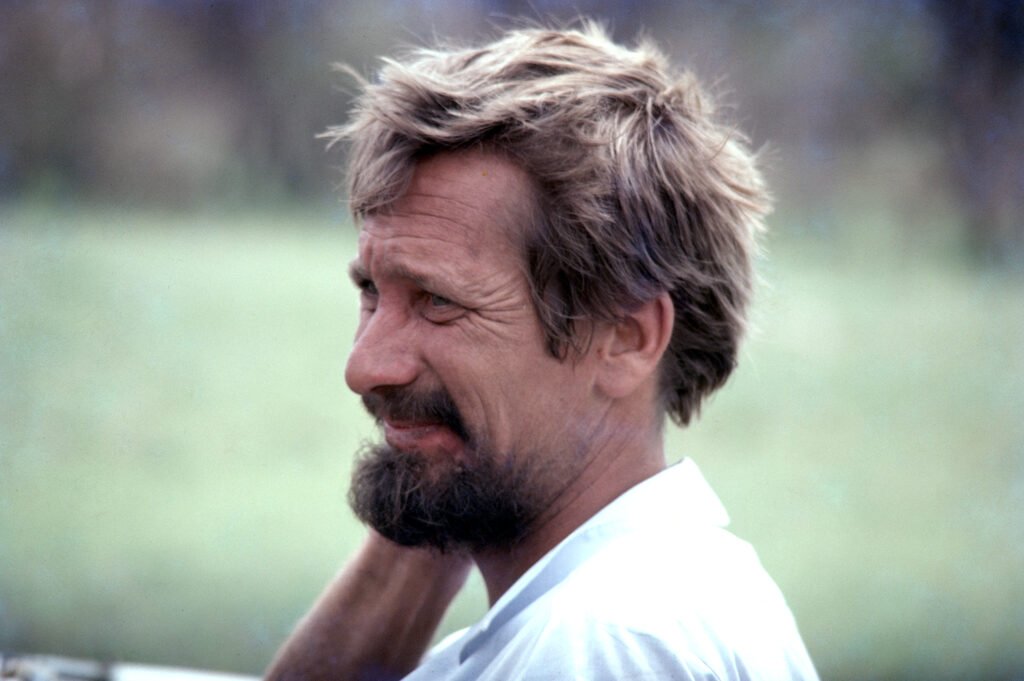
P. J. (above) and Joyce Bestelink were wonderful neighbors. Our study would not have been possible without their support.
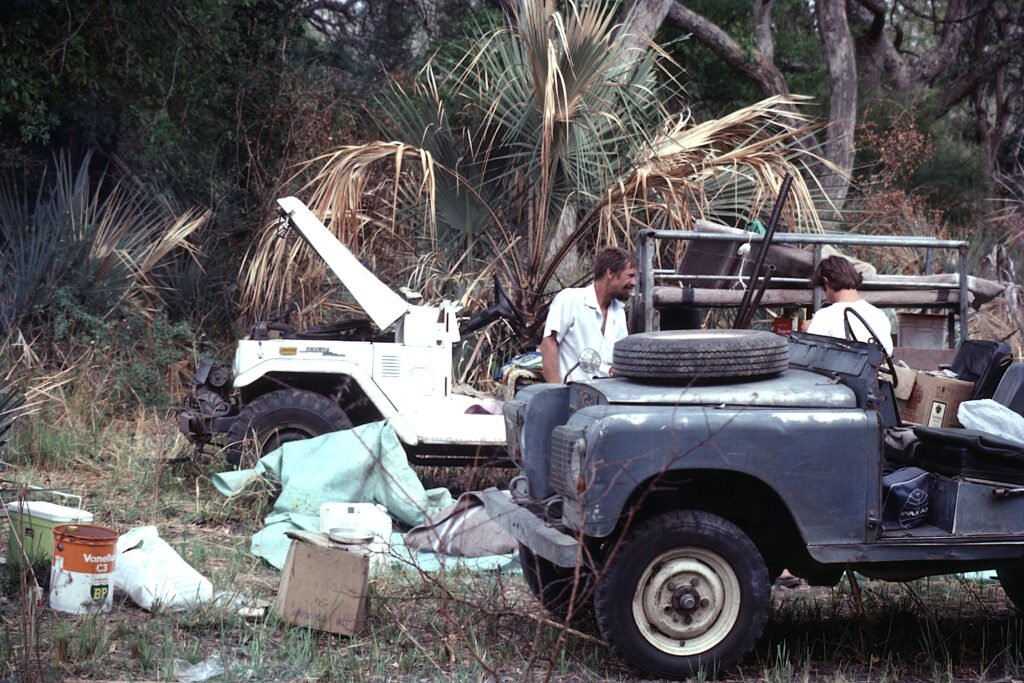
P. J. and Steve during an overnight camping trip to the top of Chief’s Island.
With a marked aerial photograph in hand, we set off for White Island. Almost immediately, we encountered our first real problem: tsetse flies. They swarmed the vehicle, slipping through every crack and seam. The person in the passenger seat became the designated “fly-swatter” instead of “shotgun.” The flies were relentless, their bites painful. We learned that if we drove faster than 20 miles per hour, we could outrun them — but the sandy, swampy terrain rarely allowed it.
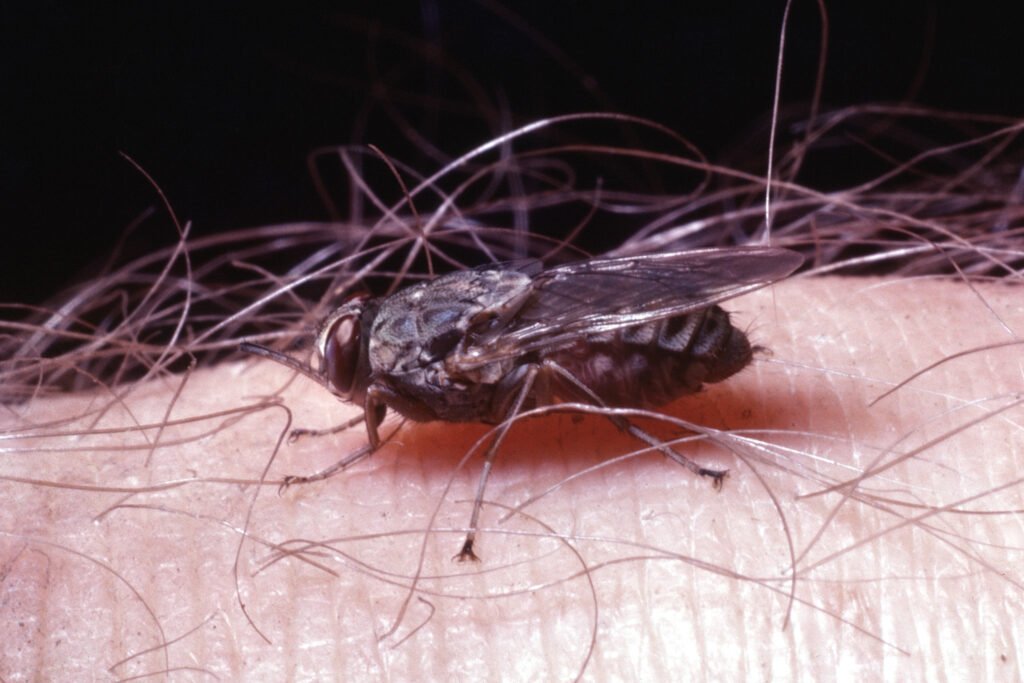
Bill volunteered to be the guinea pig for this photo, showing a tsetse fly with its proboscis inserted in human flesh. In a single feeding, a tsetse fly can consume up to twice its body weight in blood. We got skewered quite often.
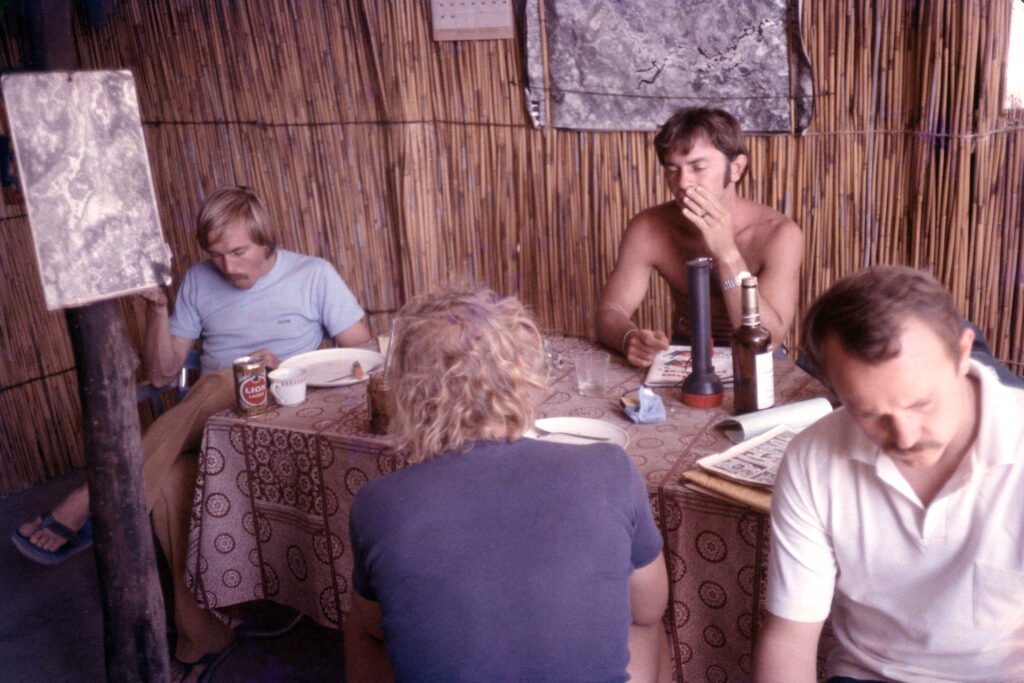
Relaxing in the Baboon Camp dining room with friends visiting from Maun. The black-and-white aerial photographs (on the clipboard to the left and on the back wall) helped us from getting lost.
On one of our first drives to White Island, we got hopelessly stuck in the mud while emerging from a deep water crossing next to a termite mound. We had discovered first hand that the soil around termite mounds turns especially treacherous when wet. We had to walk two miles back to camp and return the next day with some planks to help dig out the Rover. But something curious happened on the walk back: we noticed that the tsetse flies were not as thick. Hmm.
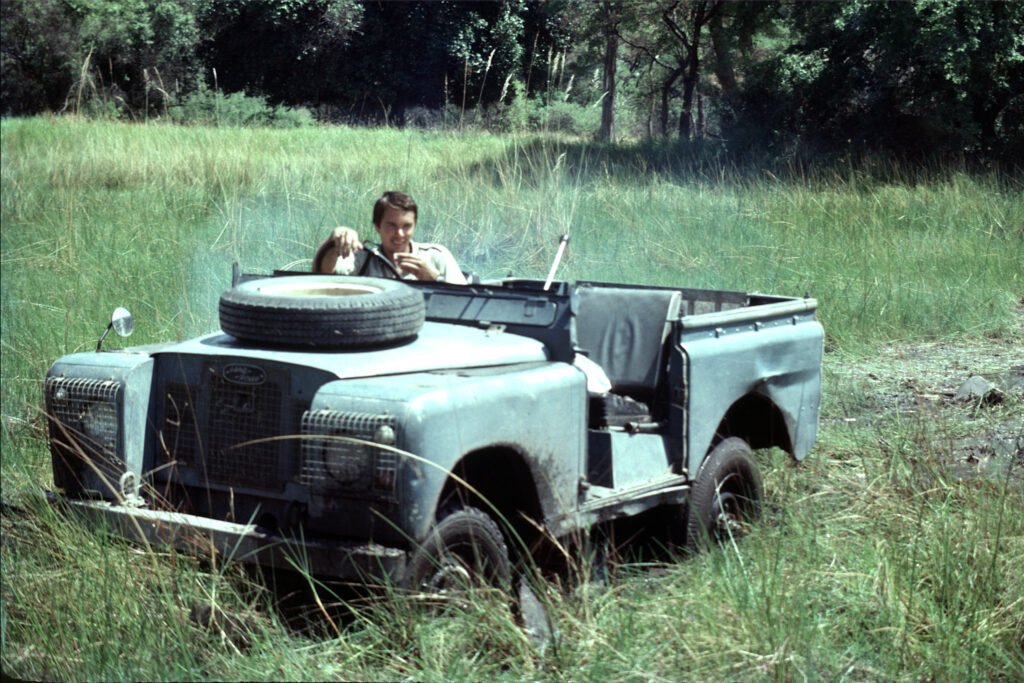
Derek Melton, sipping his morning coffee, got stuck in the mud upon emerging from a shallow floodplain. This photo series is from 1979, after the tsetses had been temporarily eradicated.
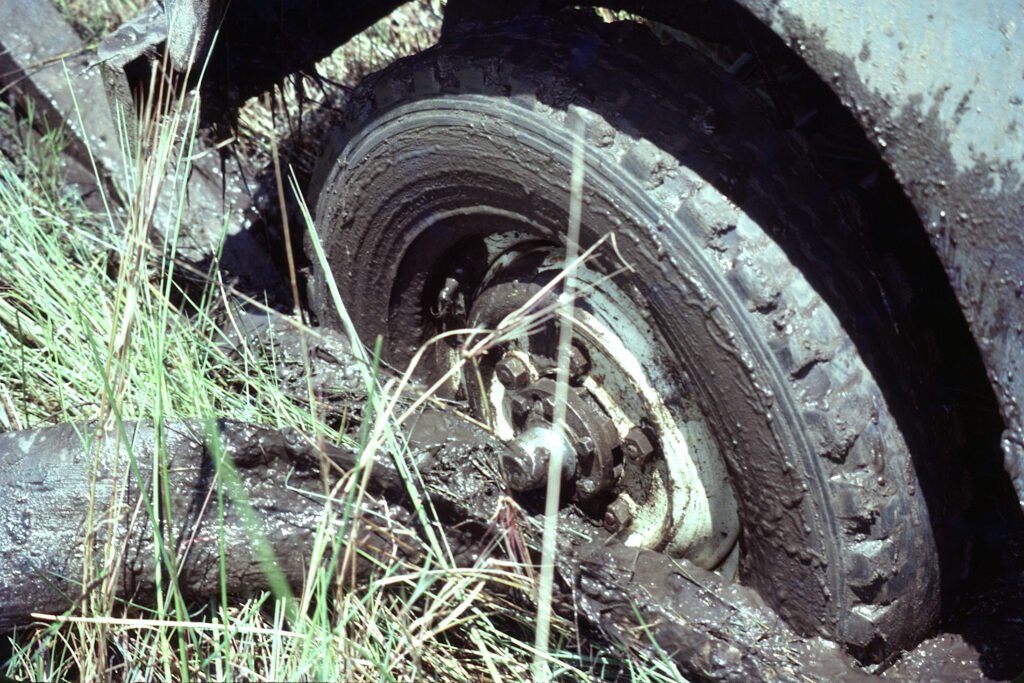
I was guilty of getting stuck more times than I could count. We always carried planks and a Hi-Lift jack for these occasions.
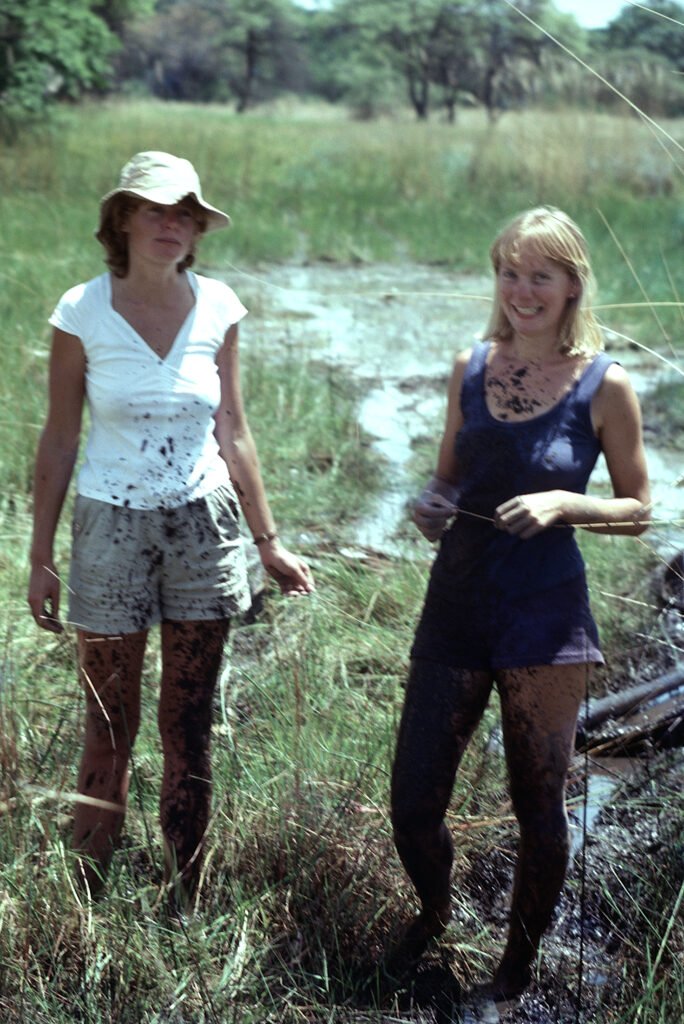
Carol and Lisbeth managed to free the vehicle, its path clearly visible in the floodplain behind them.
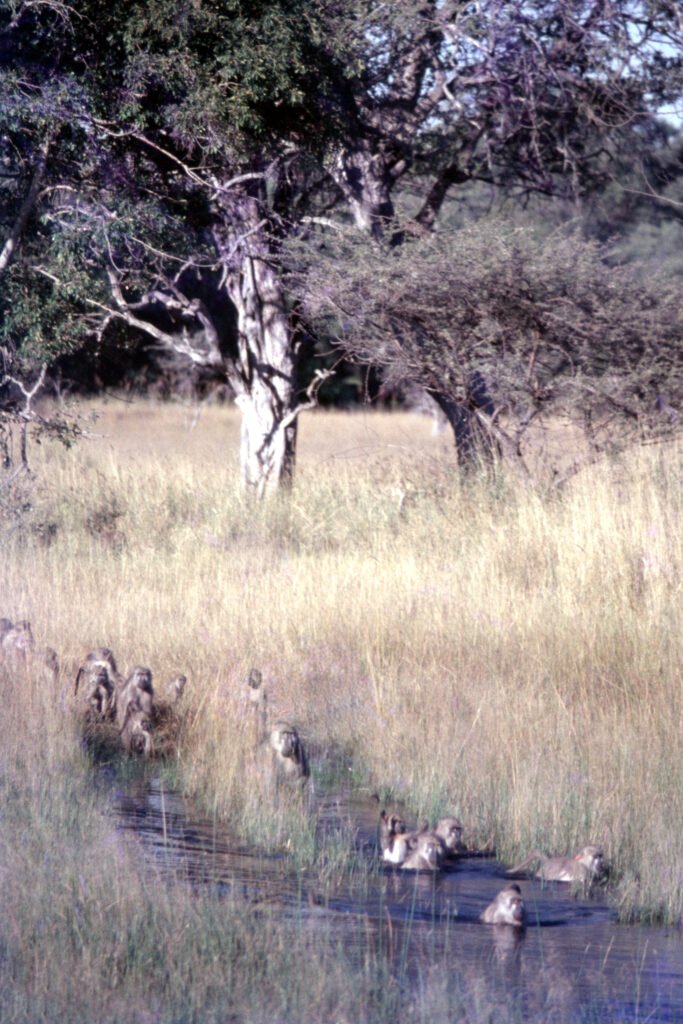
Baboons often followed our vehicle tracks at water crossings.
The vehicle finally freed, we reached the sandy middle of White Island and located a baboon troop. At first they were skittish around the vehicle, and even more so if we stepped outside. So for the next week or two we drove out to White Island almost every day and watched the baboons from the safety of the vehicle.
One day, while tracking the troop through scrubby grassland, the front axle suddenly dropped to the ground — the front left wheel had fallen into a warthog burrow. By then, we always carried planks and a Hi-Lift jack. After a long struggle, we managed to free the vehicle. We learned where most of the burrows were located, but we still occasionally required the service of the Hi-Lift jack. All along, the tsetses continued to be a major nuisance.
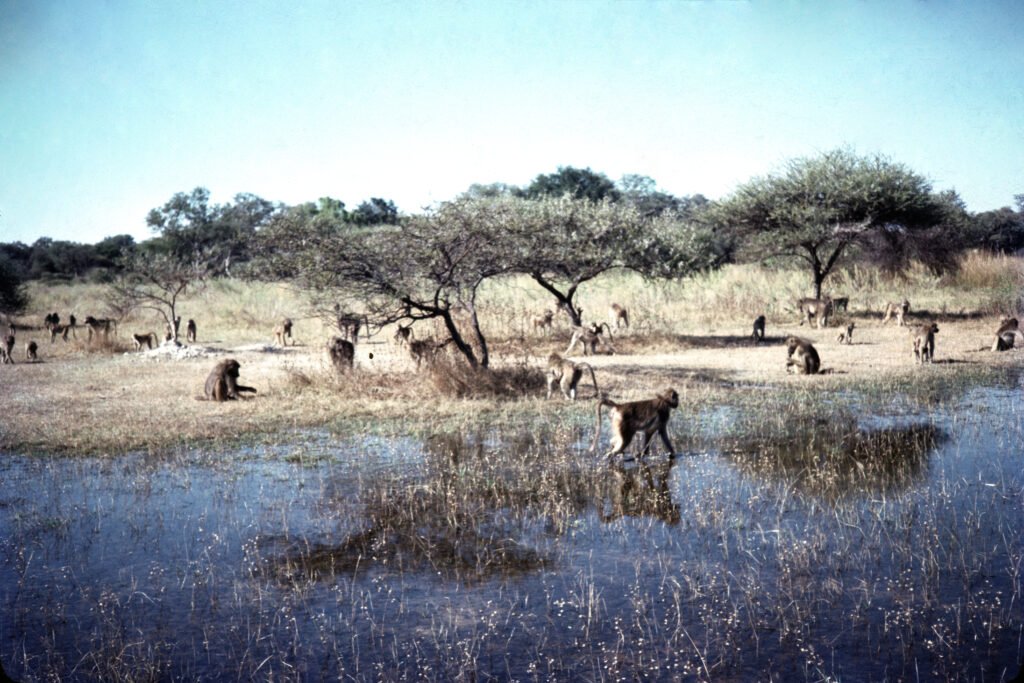
Baboons forage on White Island. During the heavy flood of 1978, water crept into normally dry areas.
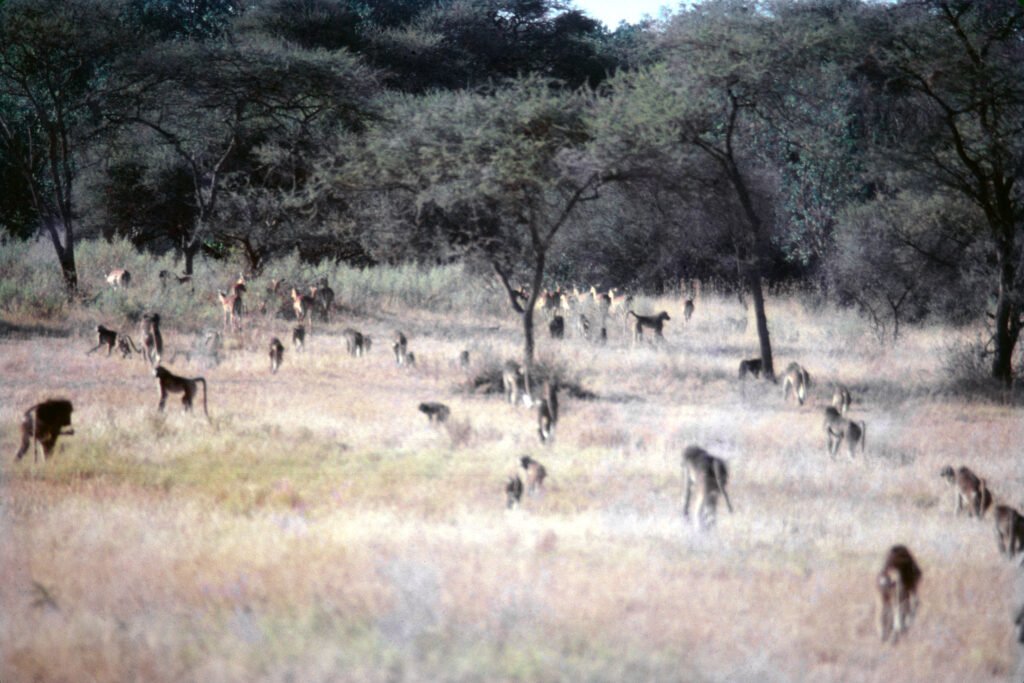
White Island baboons pass a herd of impala in the late afternoon on their way back to the sleeping trees.
More problems arose with the vehicle. We were getting regular flat tires, punctures from acacia thorns that in some cases were two inches long. We learned to avoid driving under acacia trees, although we still got some flat tires. We had to perform most vehicle repairs ourselves, from fixing flat tires to rebuilding the starter motor after repeated deep-water crossings.
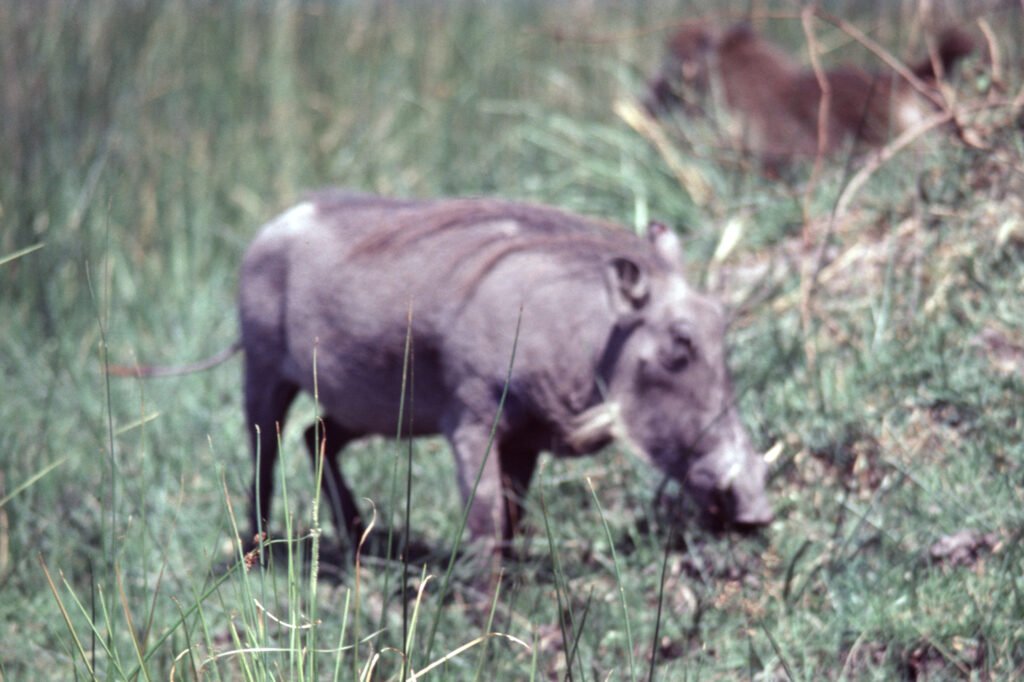
Warthogs occasionally associated with the baboons, sometimes creating uncomfortable situations for observers on foot. Here, I’m sitting on the ground about 25 yards from a warthog that has not yet noticed me.
Steve and I had previously worked at Gombe in East Africa, studying chimpanzees in a setting without roads or vehicles. We were accustomed to observing animals on foot, though Gombe’s wildlife posed fewer dangers than that of the Okavango. It soon became clear that following the baboons by vehicle was untenable. We were already beginning to recognize individuals, but tracking a specific baboon through dense brush in the Rover was nearly impossible — especially if we each wanted to observe different individuals, as we had at Gombe.
We eventually abandoned the idea of following the baboons by vehicle. Instead, we would drive out early each morning to their sleeping trees (always the same spot) then follow them on foot throughout the day before driving the four miles back to camp. Surprisingly, the tsetse flies were far more tolerable on foot than in the vehicle, and the number of bites we received each day dropped dramatically.
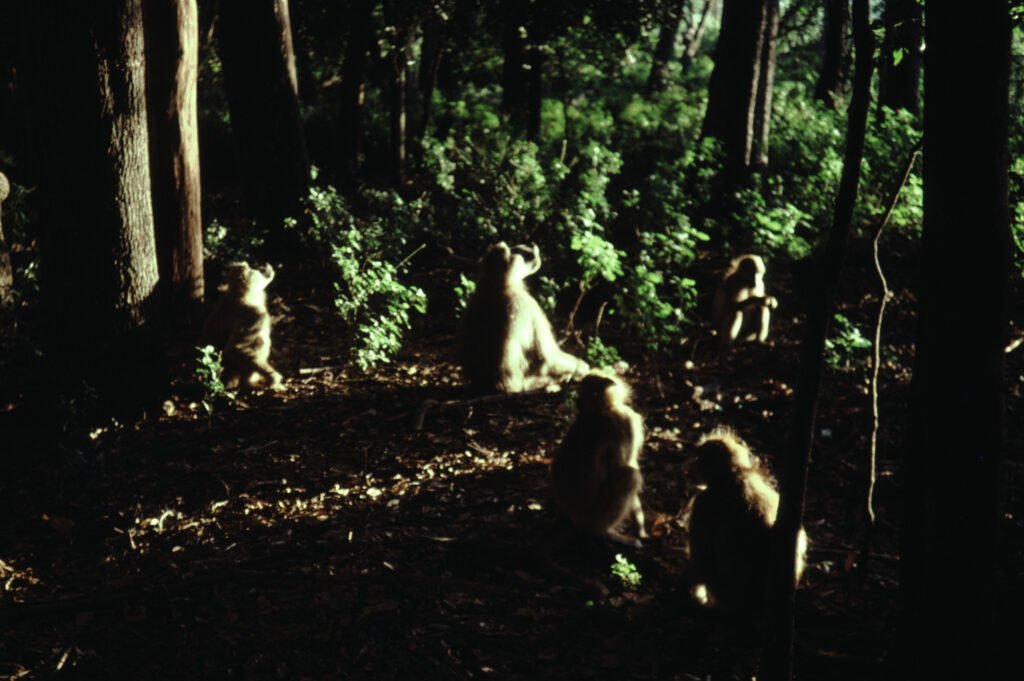
Baboons bask in the early morning sun below the White Island roost.
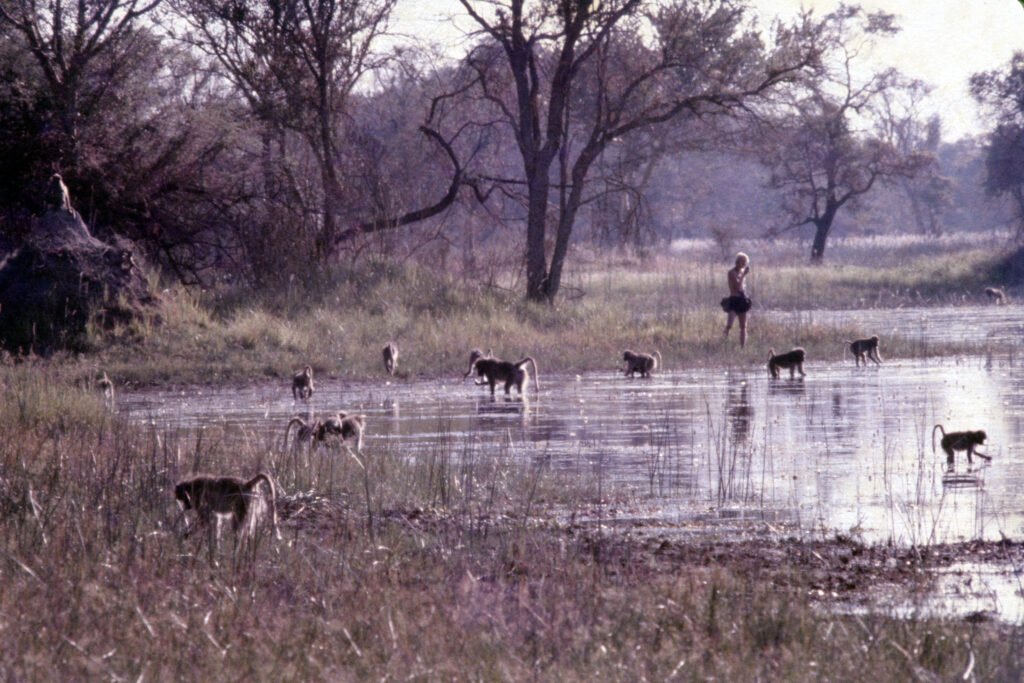
Here I am watching baboons forage in a shallow floodplain.
At first, the baboons fled from us. But we borrowed a strategy pioneered by Jane Goodall. She had gained the trust of a chimpanzee she named David Greybeard — an individual who, for whatever reason, did not fear her.
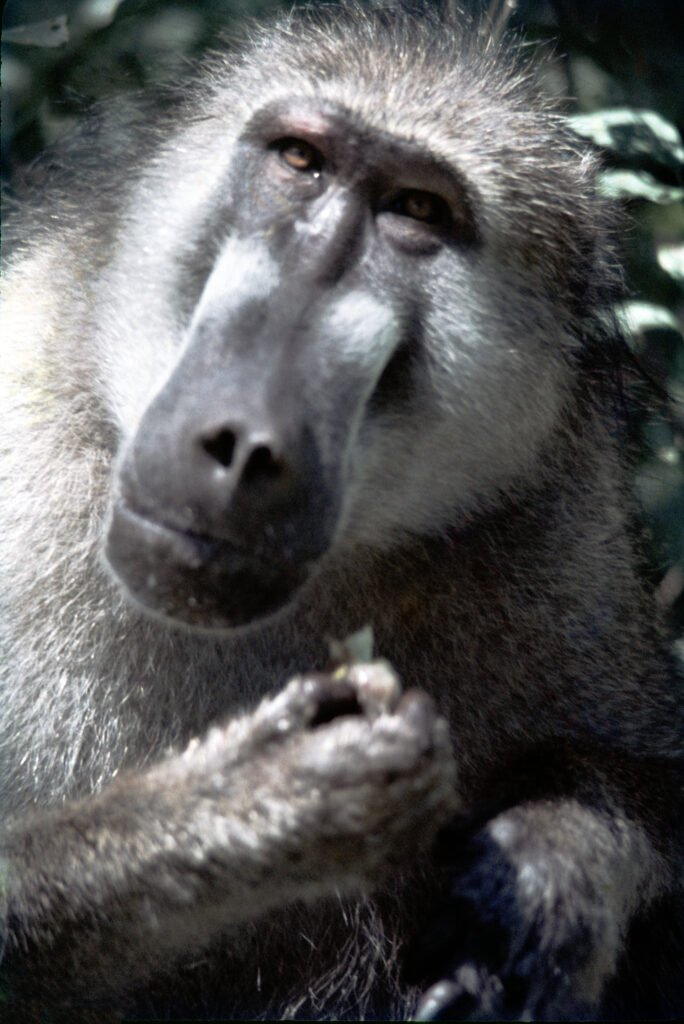
We found our own David Greybeard, in fact, two of them: an older male we named Striker and a female named Rena who showed little concern about our presence. By staying close to them, like Jane had with David Greybeard, we gradually gained the confidence and the trust of the entire troop.
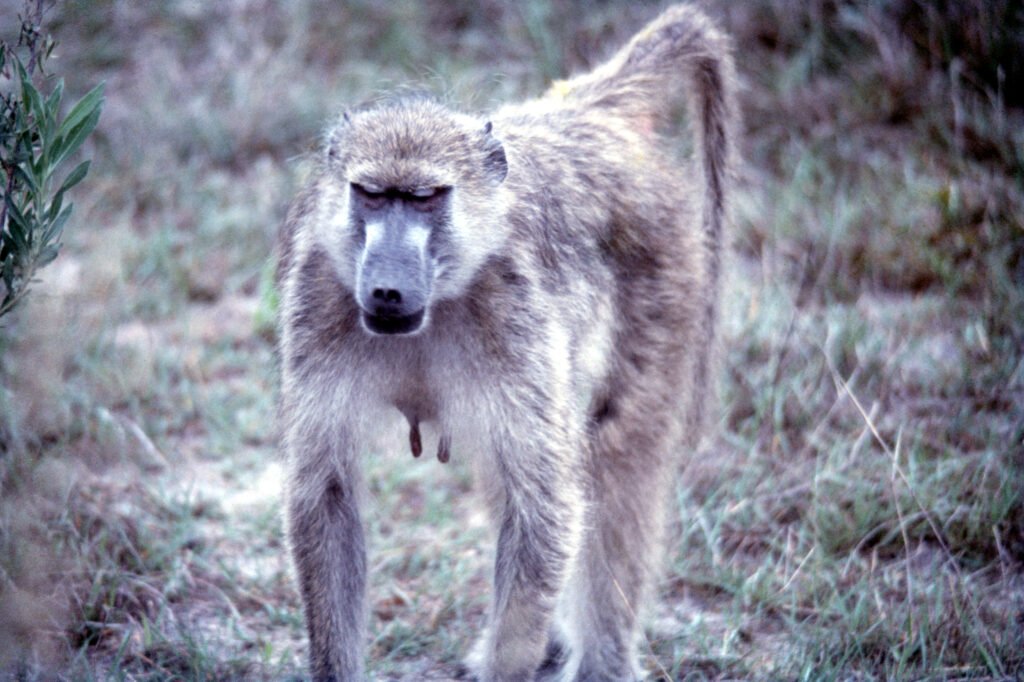
Even at the beginning, adult female Rena (WRE, above) and old male Striker (WST, right) showed little fear of us and allowed us to follow them at close range.
Following the baboons on foot was liberating. That is, until a few weeks later when three lionesses ambushed the troop (unsucessfully). It was the first time Steve and I had ever encountered lions. They stopped about 50 yards away, and we figured that our best option was to climb a tree. We scrambled into the crotch of a scrawny little tree, barely six feet off the ground. The lions looked at us — surely wondering what we were doing — then turned and walked away. We would encounter these lions many more times, including while on foot with the baboons, but they rarely showed any aggression toward us.
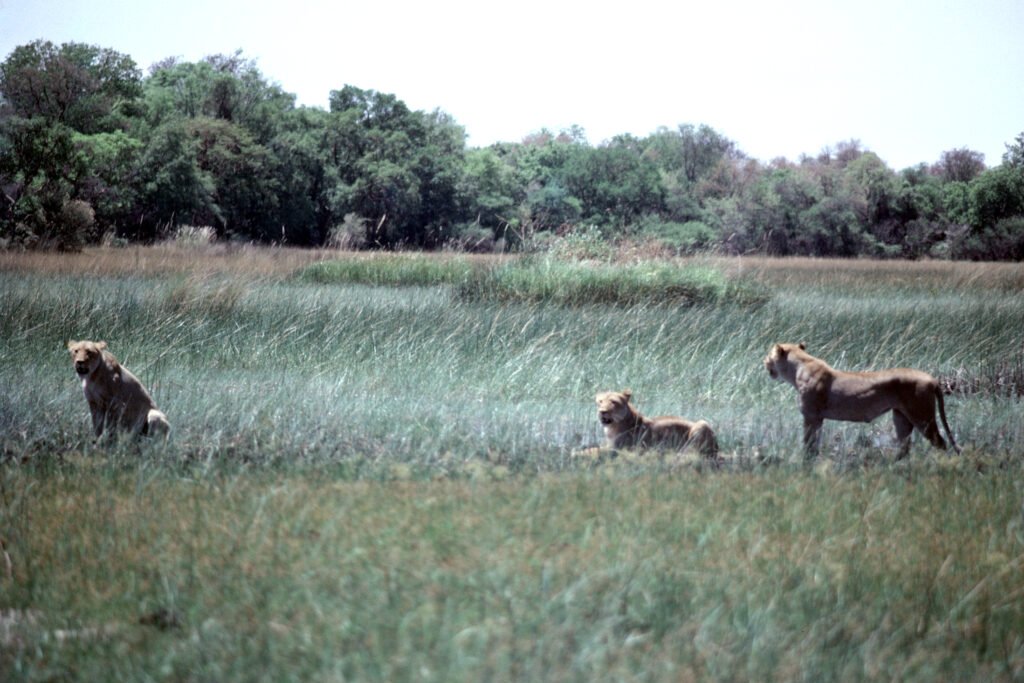
Here are our three lionesses, photographed from the “safety” of our stripped-down blue Rover.
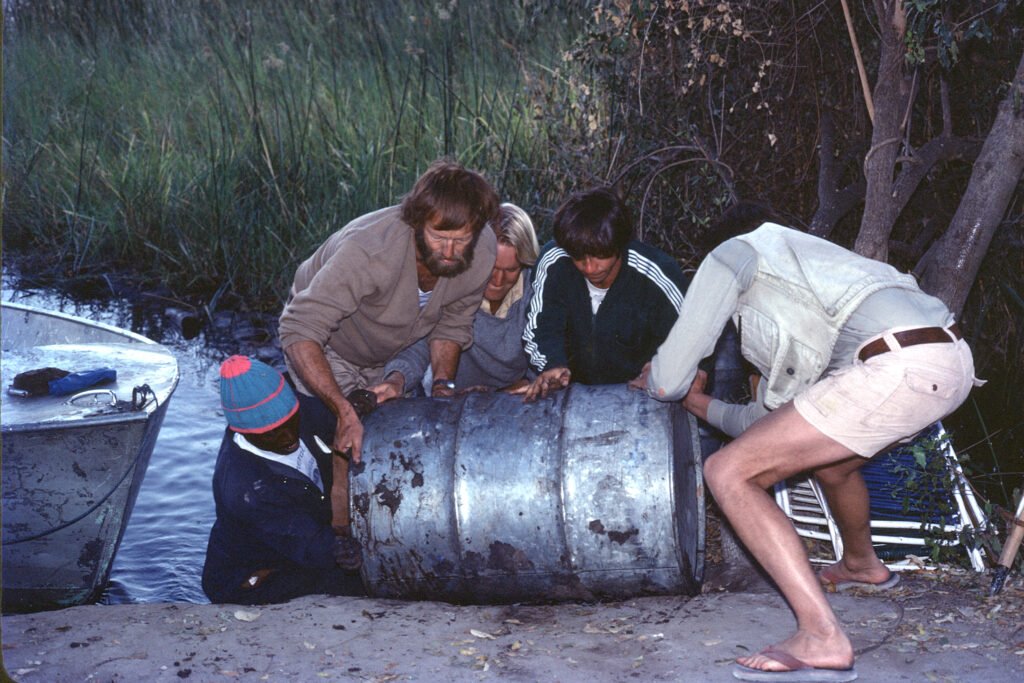
Bodimo, Bill, Curt, Steve, and Derek offload a 55-gallon drum of petrol from P. J.’s boat. With no road access from Maun, all fuel had to be brought in by boat or air.
A few months later, Bill came to visit the camp. He was surprised to learn that we were following the baboons on foot, but we made a strong case, and he came to see that our observations were far better than what we could achieve from a vehicle. The reduced tsetse fly exposure helped make the argument — as did the savings in fuel, maintenance, and vehicle wear and tear.
Early on, we also received a visit from Lloyd Wilmot, the legendary safari guide who had run a tourist camp on our island before the expansion of the Moremi Wildlife Reserve in 1976. One morning, Lloyd spoke pensively about his philosophy of life. He cleared a patch of sand and, with a finger, drew a simple graph. I can’t recall the exact axes — something like “risk” versus “probability of survival.” Across it, he drew a line and told us that above the line was where life was lived to its fullest. Lloyd truly embodied that philosophy (for example, see the photos below).
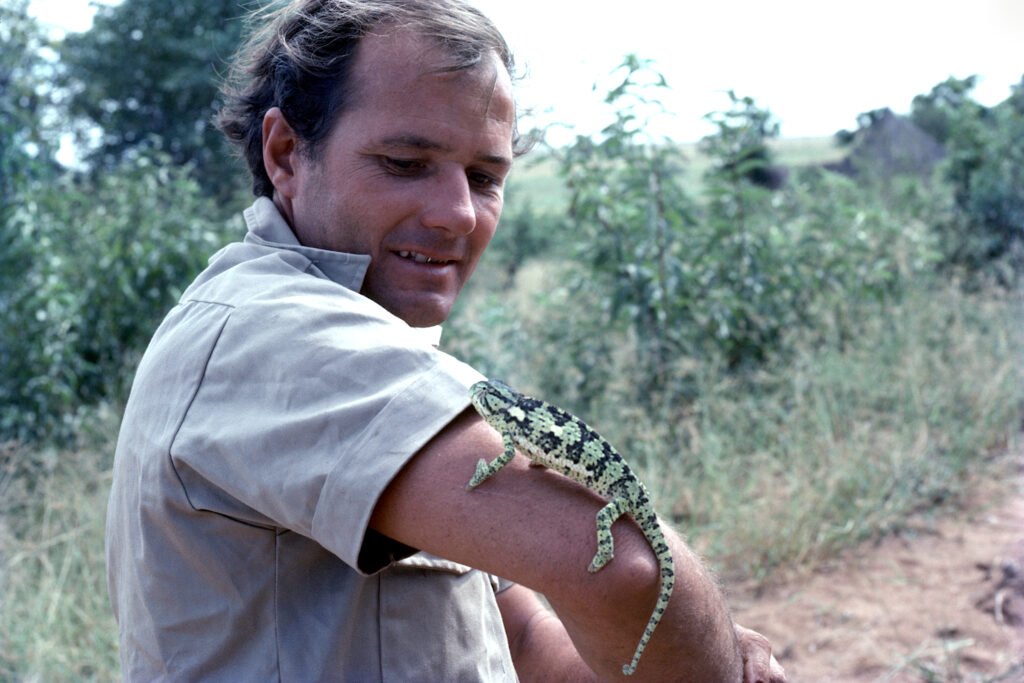
Lloyd Wilmot and friend in 1980 (photos by Bill Busse). See here for photos of Lloyd crawling up to a lion.
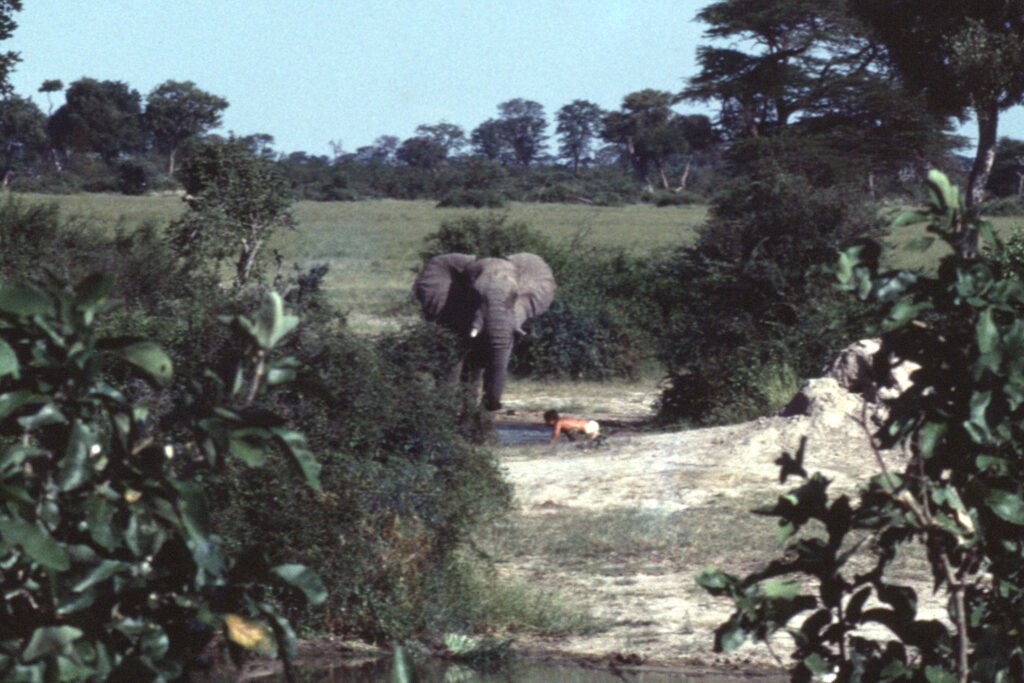
Here is Lloyd in Chobe National Park “crossing the line” by crawling in his underwear into a hippo pool with the intention of sneaking up behind an elephant to cut a few hairs from its tail with a pocket knife. Before he could get close enough, the elephant caught wind of him and buggered off (fortunately).
In the years that followed, as we walked with the baboons, we students found ourselves crossing that line more than once — usually not by choice. Those moments were as exhilarating as they were unsettling. Thankfully, perhaps miraculously, every one of us lived to tell our stories.
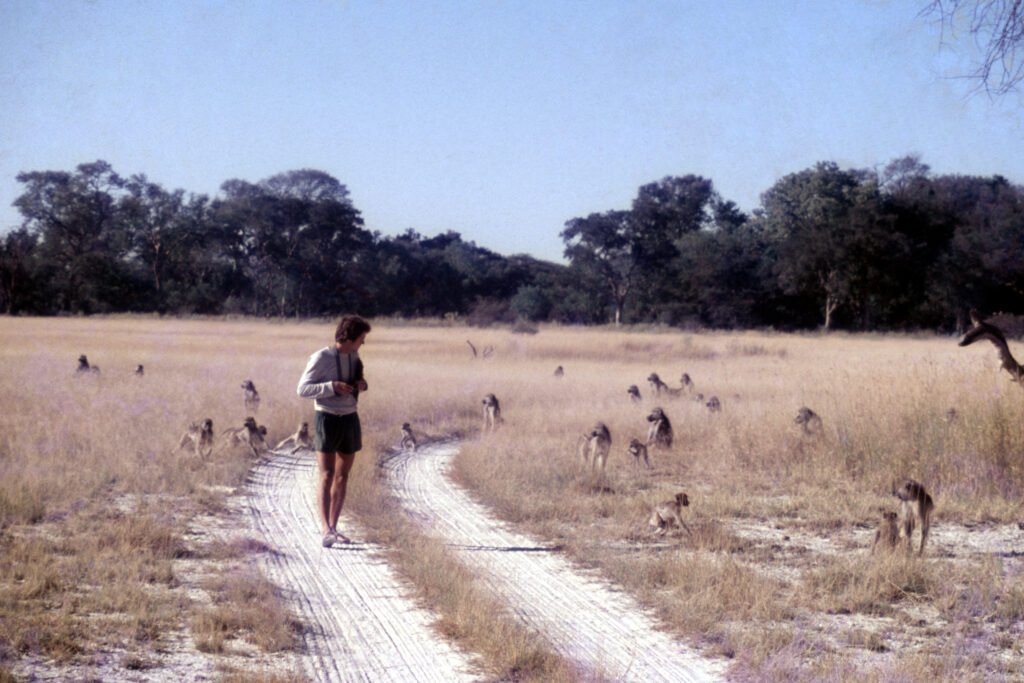
Matt Rowe watches Camp Troop baboons in 1980. The baboons provided an early warning of nearby danger.
Now, nearly fifty years later, I look back on that time with a mix of disbelief and gratitude. In your twenties, you feel invincible. At the time, abandoning the vehicle and setting out on foot seemed perfectly reasonable. But the dangers were real, and our only safeguards were our wits, our judgment, and, oddly enough, the baboons themselves.
Curt Busse
April, 2026
- Xaxaba is now a high-end luxury tourist camp called Eagle Island Lodge. P. J. would go on to found and operate Okavango Horse Safaris from 1986 until 2025. ↩︎