Infanticide in Two Populations of Savanna Baboons
by D. Anthony Collins, Curt Busse, and Jane Goodall
In a landmark 1974 paper, primatologist Sarah Blaffer Hrdy proposed a controversial explanation for infanticide among langur monkeys. Rather than viewing the killing of infants as a result of social breakdown or overcrowding, Hrdy argued that it could be an evolved reproductive strategy. She suggested that when a new male takes over a troop, he may kill unweaned infants that were likely fathered by the previous male. The loss of these infants causes the mothers to return to fertility sooner, giving the new male a chance to sire his own offspring more quickly.
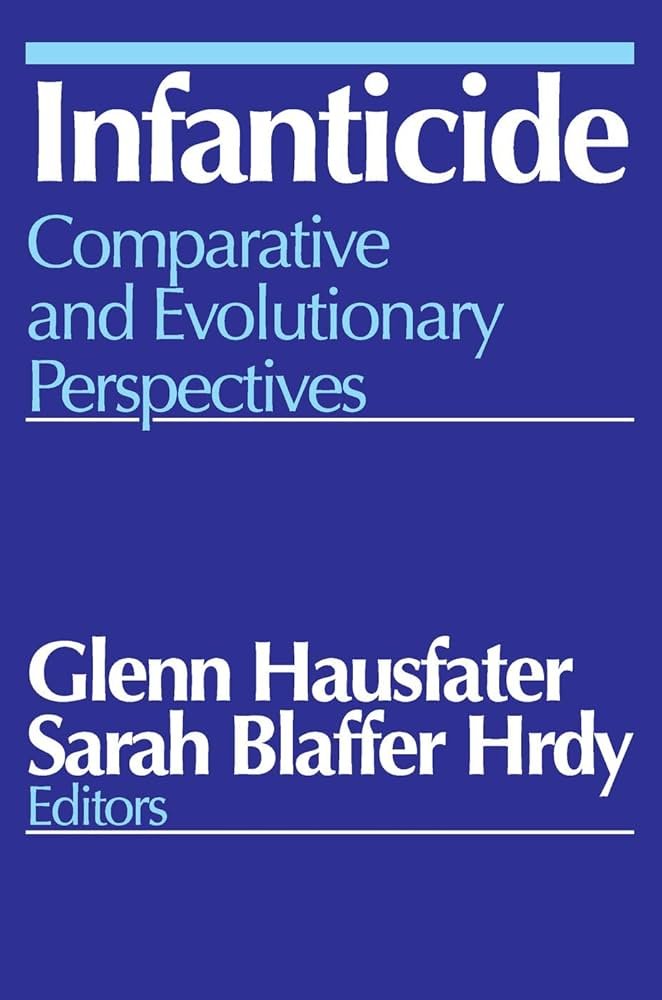
As evidence from studies of different primate species accumulated, Hrdy helped organize a Wenner-Gren conference at Cornell University in 1982 to bring together researchers investigating this phenomenon. Scientists from around the world attended, including the renowned gorilla researcher Dian Fossey. The discussions at that meeting soon led to the book Infanticide: Comparative and Evolutionary Aspects. For this volume, Anthony Collins, Jane Goodall, and I were invited to contribute a chapter describing our observations of baboons in Tanzania and Botswana.
With permission from Taylor & Francis Group, we are pleased to make the full book chapter available here as a PDF so that readers can view the original research in detail. The full citation is:
D. A. Collins, C. D. Busse, and J. Goodall. 1984. Infanticide in two populations of savanna baboons. In G. Hausfater & S. B. Hrdy, eds., Infanticide: Comparative and Evolutionary Aspects, pp. 193–215, New York: Aldine.
Copyright © 1984 by Aldine, New York. Reproduced
by permission of Taylor & Francis Group.
Our chapter brought together long-term observations of baboons from two field sites: olive baboons (Papio anubis) at Gombe National Park in Tanzania and chacma baboons (Papio ursinus) in the Moremi Wildlife Reserve in Botswana.
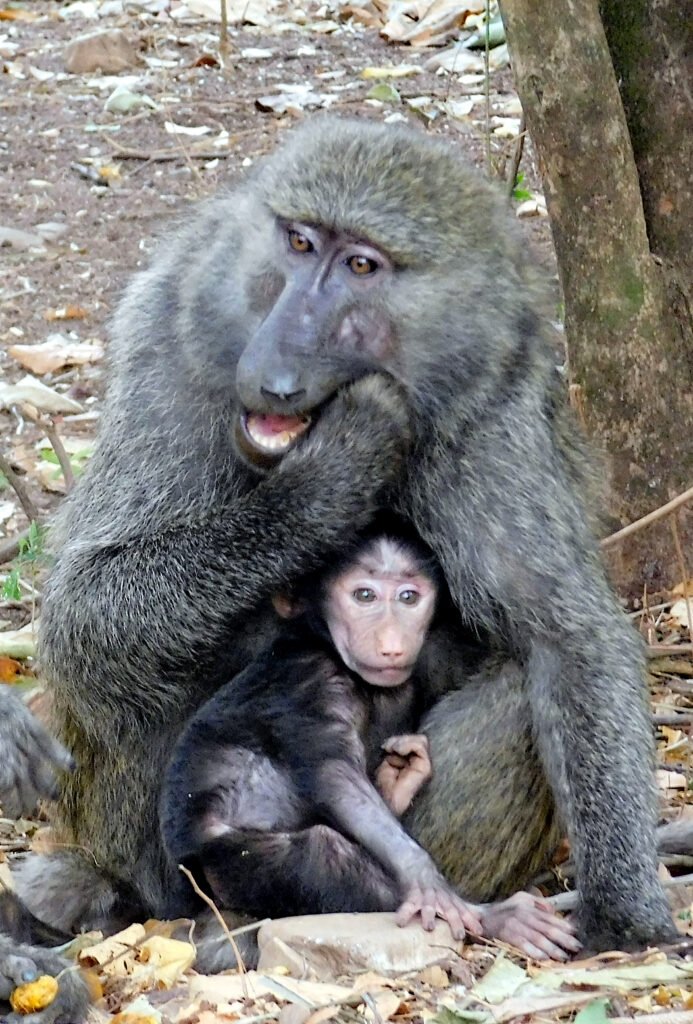
Mother and infant olive baboons (Papio anubis) at Gombe National Park, Tanzania. 
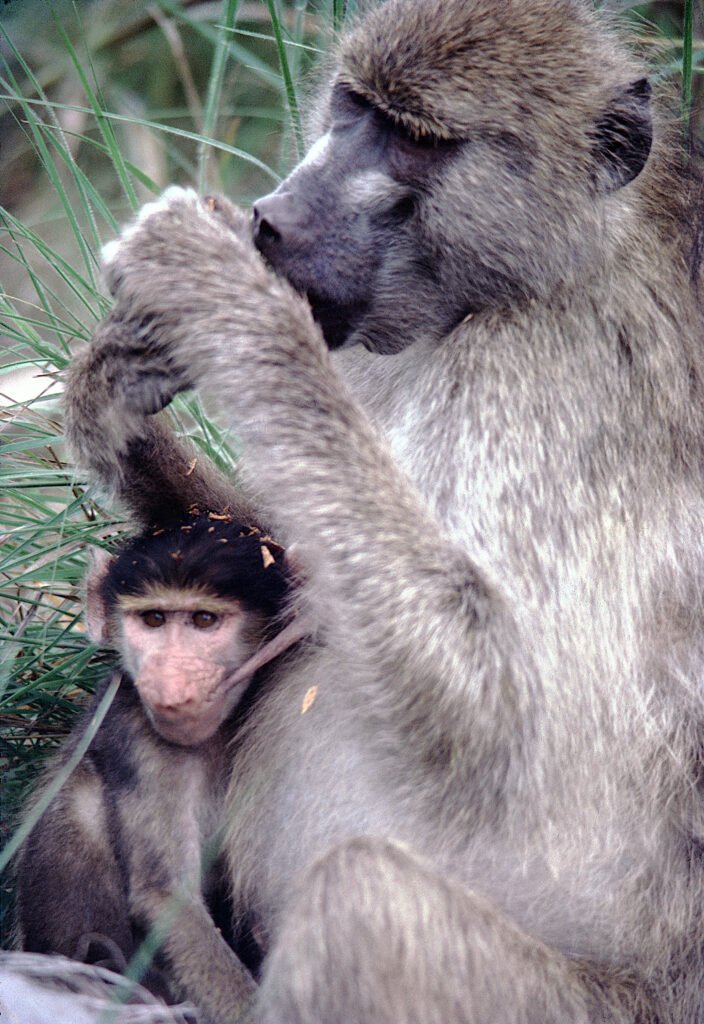
Mother and infant chacma baboons (Papio ursinus) at the Moremi Wildlife Reserve, Botswana.
At the time, most documented cases of primate infanticide came from species like langurs that live in single-male groups, and it had been reported rarely in species like baboons that live in large troops with several adult males. Nevertheless, we documented several cases in which infants were seriously injured or killed by other baboons, including adult males. In multiple cases the attackers were recent immigrant males who had joined the troop after the infants were conceived and therefore could not have been their fathers. Although females resumed reproductive cycling sooner after losing an infant, there was only limited evidence that the attackers subsequently mated with the mother.
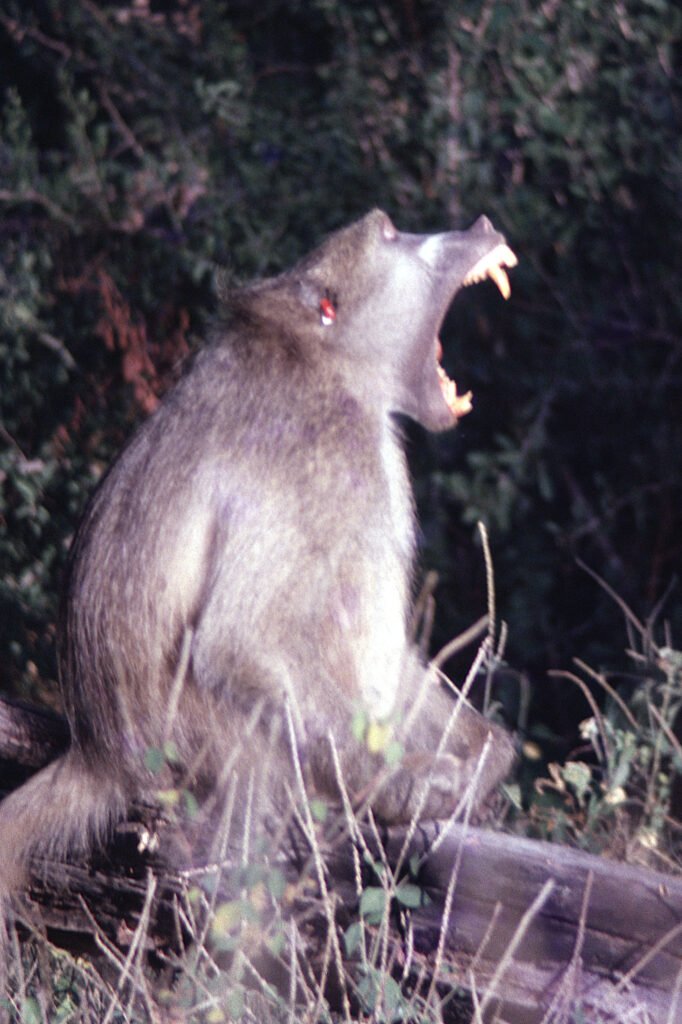
An adult male chacma baboon yawns, exposing his impressive canines. When directed at other baboons, yawning usually serves as a threat display. In this case, however, no other baboons were nearby, so it was likely just an ordinary yawn.
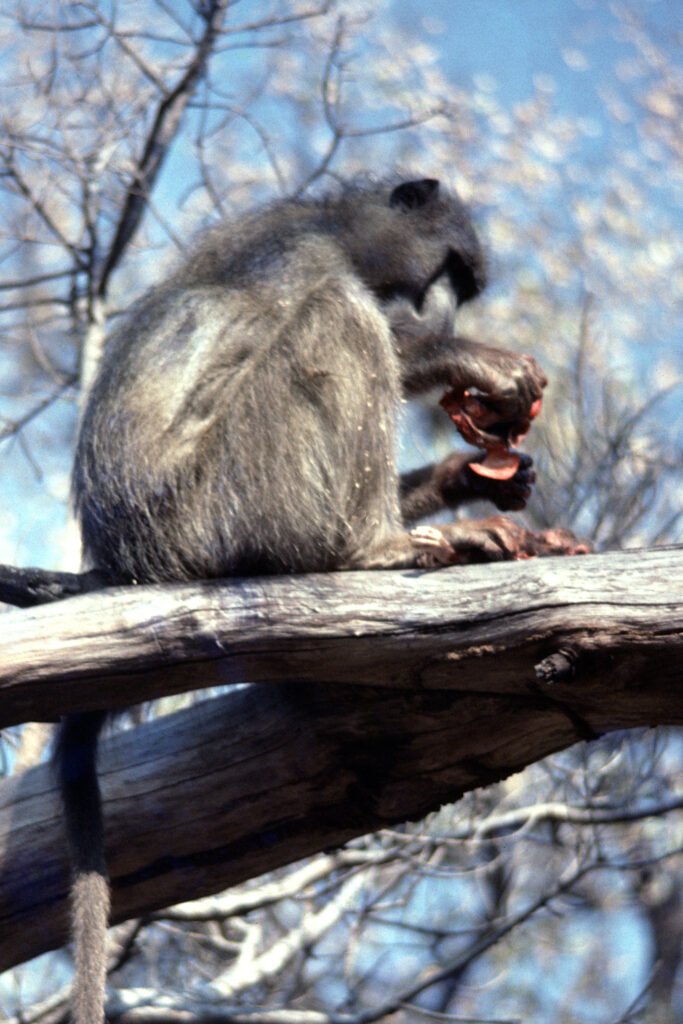
On September 1, 1979, an adult male chacma baboon (CBB) that had recently immigrated into Camp Troop (Moremi) killed and partially consumed a newborn infant after researchers had darted and tranquilized the infant’s mother.1 (photo by Lisbeth Nygaard Nilsson).
At the same time, our findings suggested that the causes of infant killing are not simple. Some infant deaths occurred during periods of intense social tension, such as when new males entered a troop, when troops encountered one another, or when dominance relationships among males were unstable. In other cases, infants died after rough handling or “kidnapping” by other baboons. These observations indicated that both reproductive competition and social disturbance may contribute to infant mortality. The events were rare and often difficult to observe directly, but the studies helped demonstrate that infant killing can occur even in complex multi-male primate societies.
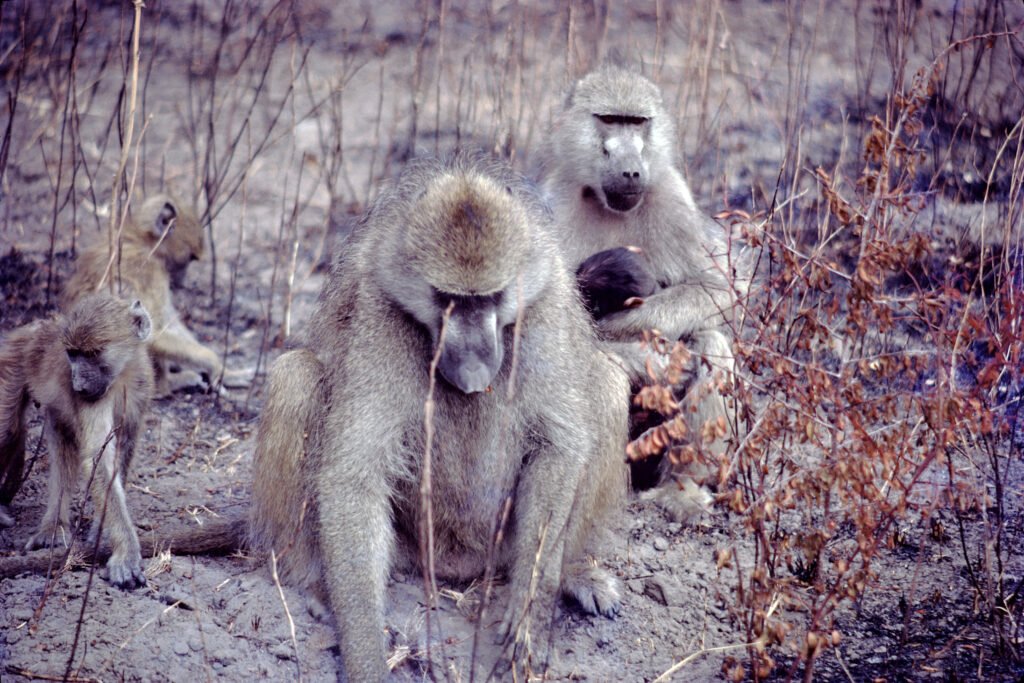
An adult female chacma baboon (WPG) holds her infant and sits calmly behind an adult male (WCK) who digs for roots after a recent fire. The male was a long-term resident of the troop and a possible father of the infant.
- The darting was part of a study examining how physiological measures relate to factors such as female reproductive state and social dominance. See:
Melton, D. A. and C. L. Melton. 1982. Blood parameters of the wild chacma baboon, Papio ursinus. South African Journal of Zoology 17: 85-90. https://www.tandfonline.com/doi/abs/10.1080/02541858.1982.11447785 ↩︎