The Ghost in White Pants
My first glimpse of the spiritual side of Jane Goodall came from her unexpected reaction to a ghost story told over dinner at her camp in Tanzania.
It was January 1974 when I arrived at the research station in Gombe National Park. I was twenty-one years old, a student volunteer helping collect data on chimpanzee behavior. There were about a dozen of us students living at Gombe, half studying chimpanzees and the other half studying baboons. Our days were long and demanding. From sunrise to sunset, we followed our subjects through the rugged forest, at times drenched by sudden downpours.
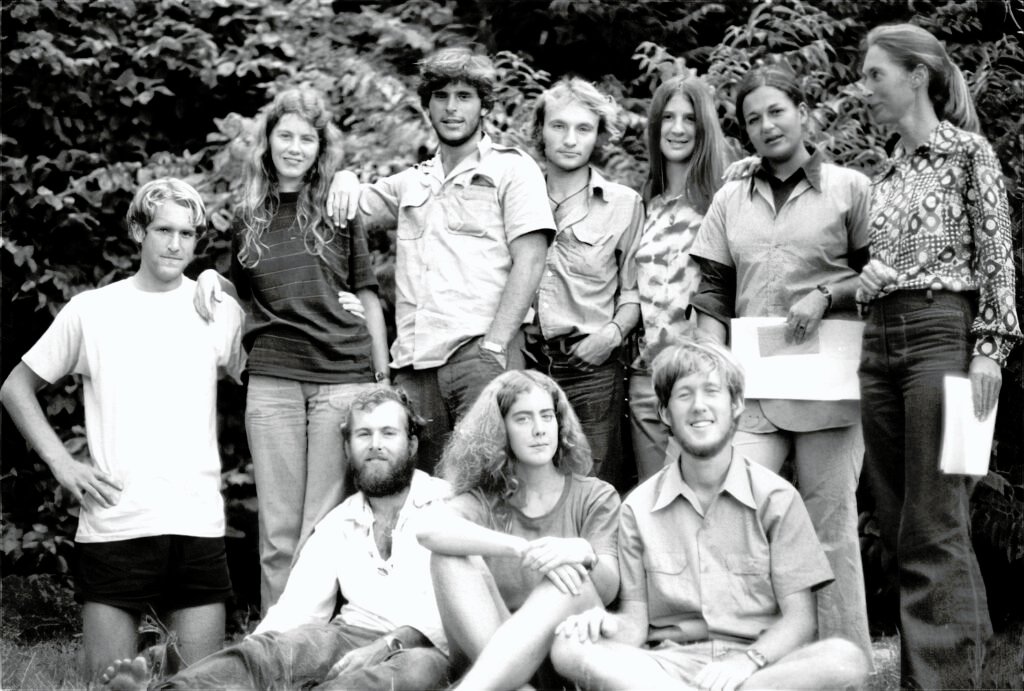
Jane (far right) with her students in January, 1974. That’s me kneeling on the far left, just days after my arrival (photo courtesy of Emilie van Zinnicq Bergmann-Riss).
Every evening, we gathered for dinner at the Mess (photo, below). After long days in the forest, it was a time to relax and share stories from the field. Jane joined us once or twice a week, making those evenings especially memorable. Although she was facing personal challenges at the time, it was clear that she genuinely enjoyed being with us students. In a letter to her family in early 1974 she wrote that the morale of the researchers was “very high.” Indeed it was.
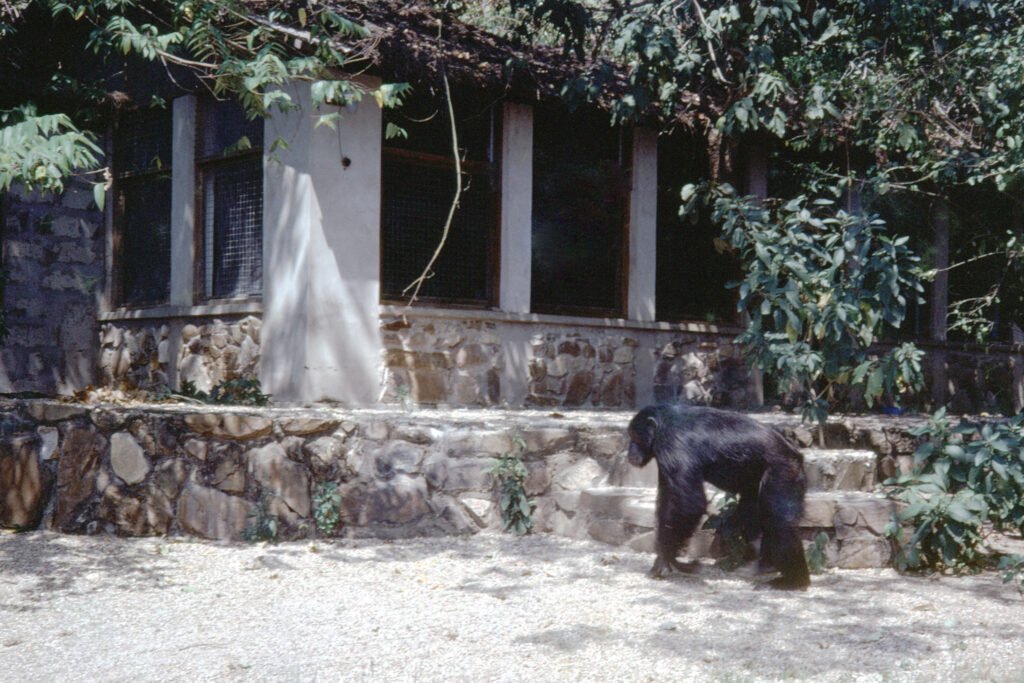
The alpha male chimpanzee Figan stands in front of the Mess in 1974. 
One evening in late January, a student told a strange story she had just heard from one of Jane’s Tanzanian staff members. Someone — perhaps a staff member or a relative — had seen a ghost walking through the forest along a trail at night. The eerie detail was that the ghost appeared to be wearing only a pair of white pants. There was no head, no torso — just white pants moving silently through the moonlight.
The story gave me the chills. I had grown up in a quiet California suburb, where ghost stories were easily dismissed. Now I was thrust into a remote African forest where the nights felt primeval and the imagination was quick to wander. I kept quiet, trying not to reveal that I was genuinely spooked.
A few of the students admitted they hoped they would never run into this mysterious apparition. Then Jane spoke and completely changed the tone of the conversation.
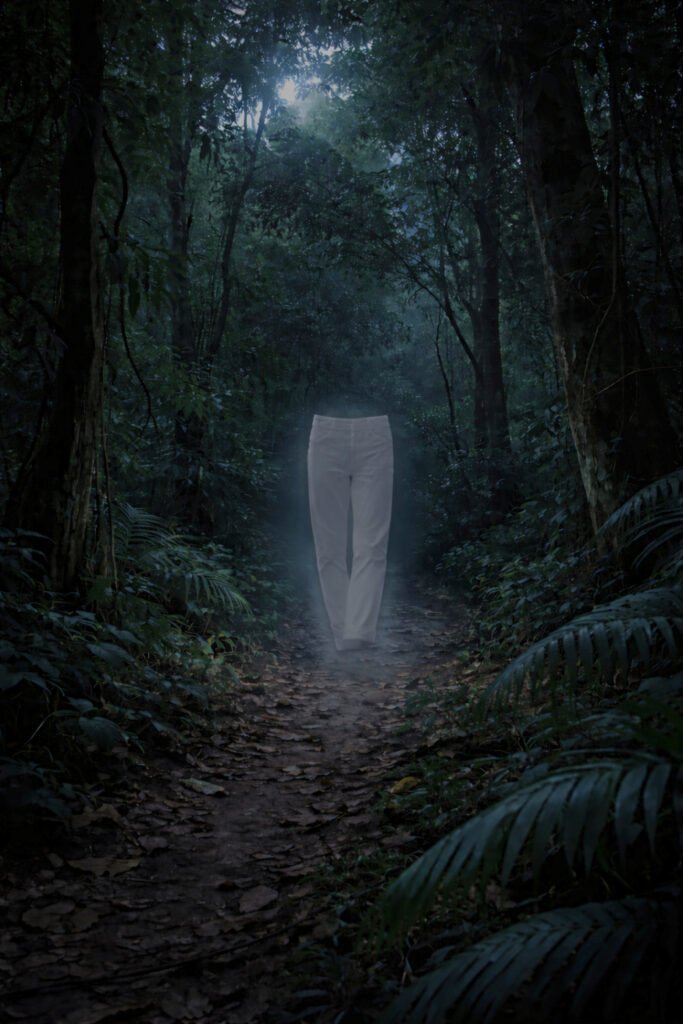
“I’d like to see this ghost,” she said calmly. “And I wouldn’t be afraid at all.”
Her matter-of-fact response stunned me. Did this world-famous scientist believe in the supernatural? For a moment the table fell silent. Then Jane added pensively, “Ruth had a pair of white pants. This might very well be Ruth’s ghost.”
I was dumbfounded. Jane wasn’t kidding. Soon I learned the tragic story behind her comment. Five years earlier, one of her students, Ruth Davis, had died in a terrible accident after falling from a cliff beside a waterfall in the forest. Jane ended the conversation by saying that it gave her comfort to imagine Ruth’s spirit still roaming the hills of Gombe.
Comforting or not, the story frightened me.
When dinner ended and everyone grabbed their flashlights to hike up the dark forest trails to their huts, I made sure to stick close to a group heading my way. The huts were scattered across the hillside beyond the Mess, and mine was the farthest: a steep 12-15 minute trek up to the edge of the unenchanted Plum Tree Thicket. One by one the others peeled off toward their huts until, inevitably, I was left alone for the final sixty yards.
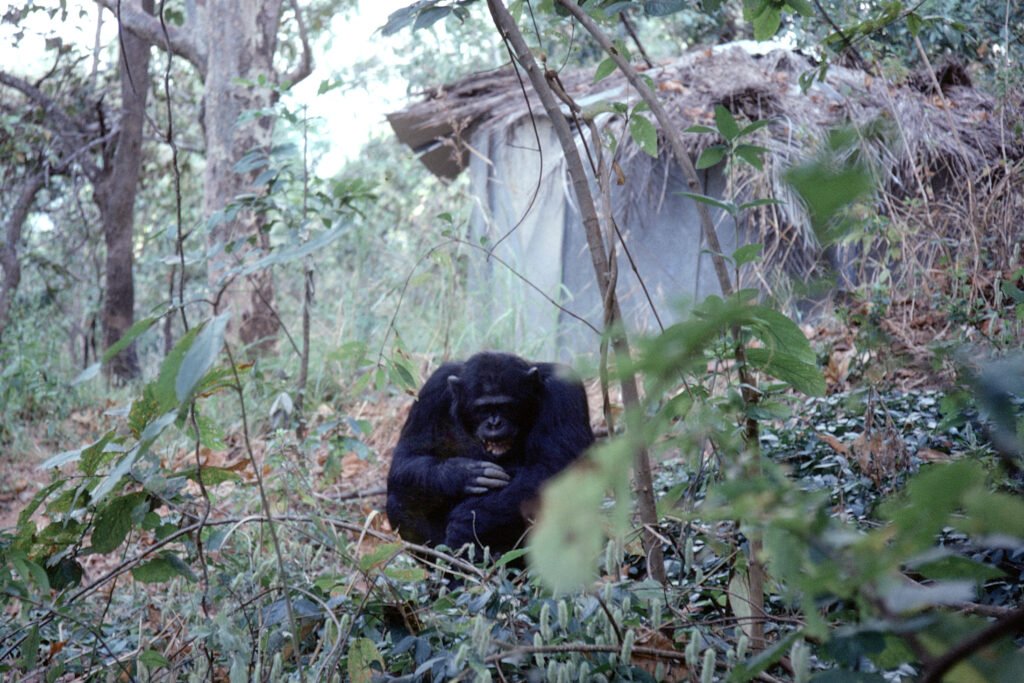
Figan sits near my hut, a simple pre-fabricated metal rondavel large enough for a bed and a small desk.
For days I repeated this nightly ritual, walking with others as far as possible before facing the last stretch by myself. I never told anyone why. I wasn’t worried about bushpigs or snakes. My real fear was that one night I might encounter a pair of ghostly white pants floating through the darkness. Had that happened, I probably would have left Gombe on the next water taxi.
A couple of weeks later the story resurfaced again at dinner. There had been no sightings, though Jane still expressed a genuine hope that she might see the ghost one day. Meanwhile the idea continued to haunt me whenever I walked alone at night.
One afternoon, while following chimpanzees with one of Jane’s Tanzanian researchers, Hamisi Matama, we made our way down a ridge known as Sleeping Buffalo. We stopped in a clearing that opened to a panoramic view of Lake Tanganyika. Despite my limited Swahili, I understood as Hamisi slowly explained that this was where Ruth was buried.
I finished my eight-month stay at Gombe in September 1974. It was truly a once-in-a-lifetime experience, and thankfully I never encountered any ghosts.
Over the next twenty-five years I gradually lost touch with Jane. Then in 1999 she published Reason for Hope, a book in which she opened up for the first time about her spiritual journey, as well as some of her biggest moments and challenges in life. It helped me understand the perspective behind that long-ago dinner conversation. What a wonderful book. Bravo, Jane!
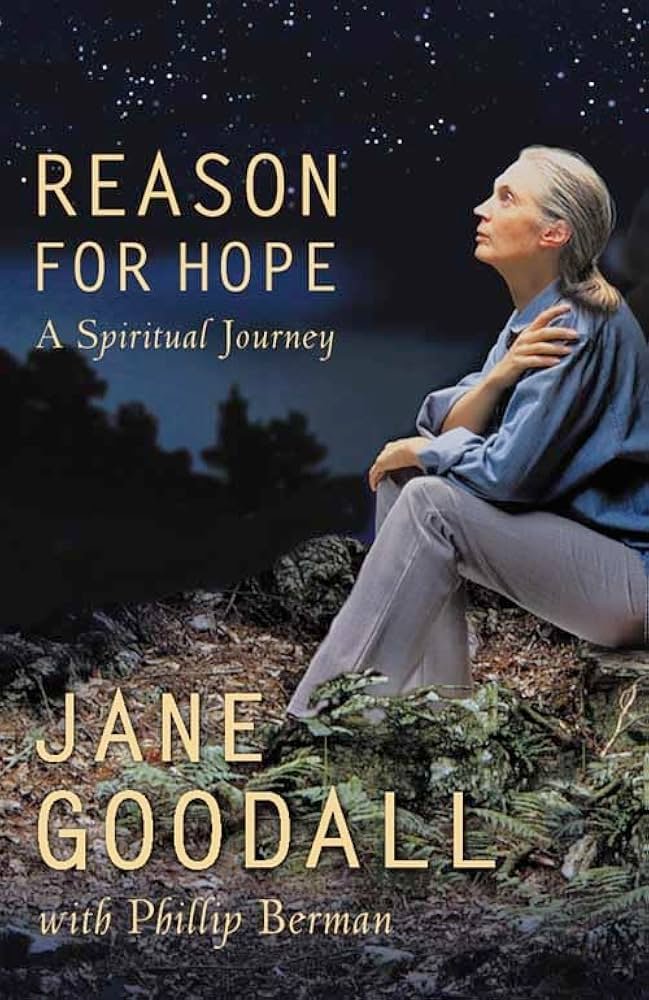
The book starts with a description of a profound experience she had in the spring of 1974 while visiting Notre Dame Cathedral in Paris. As the organ music filled the cathedral, she suddenly felt a sense of ecstacy and a connection to a power much larger than herself. Later, in the months following the death of her husband Derek Bryceson, she sometimes sensed his presence so vividly that it strengthened her belief in a spiritual life beyond what science can explain.
She also wrote about Ruth: “for a long time, I sensed her presence; a gentle, quiet presence, at peace in the forests where, she had often told me, she spent some of the happiest days of her life.”
Jane often said that her deepest spiritual experiences occurred in the forests of Gombe. Sitting alone among the trees, listening to the sounds of the forest, she felt an overwhelming sense of peace and connection with the natural world. For her, spirituality was rooted in awe and wonder — an awareness of the beauty and interconnectedness of life. She even suggested that her chimpanzees might experience something similar when they performed their dramatic displays at waterfalls (photo, right).
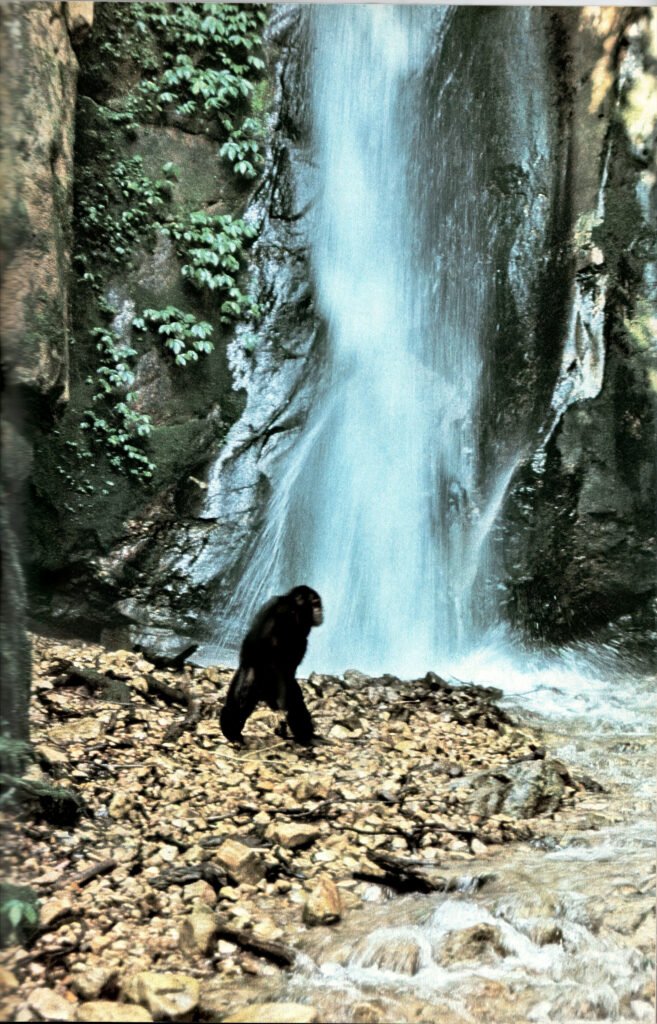
Figan charges bipedal and hurls rocks along the base of the Kakombe waterfall, Jane’s favorite place at Gombe.1
In 2009, during one of Jane’s lecture tours, she visited Puerto Rico, and my wife Arlene and I had the pleasure of spending some time alone with her at a picnic table in the Botanical Garden near our home. We reminisced about the old days at Gombe while taking in the surrounding flowers and lush vegetation. It didn’t occur to me to ask her about the ghost story, but at one point Arlene asked her directly if she believed in God. Jane slowly raised her arms and gestured to the magnificent gardens.
“Just look around us,” she answered.
The story of the ghost in white pants lay dormant in the back of my mind for decades. Then in 2018 Jane’s biographer, Dale Peterson, published The Ghosts of Gombe, a book about Ruth Davis’s life and tragic death. I read it in a single sitting, fully expecting to finally learn more about the mysterious white pants. After all, the title itself included the word “ghosts.”
But the book never mentioned any white pants.
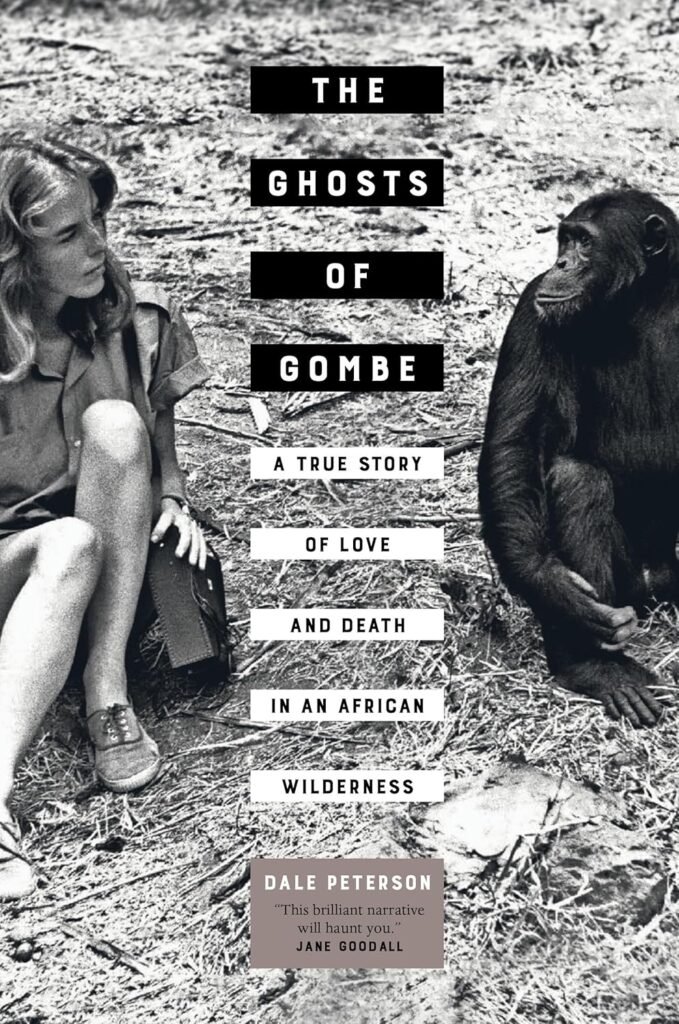
The book cover shows Ruth with Figan.
Instead, Peterson told the remarkable story of a quiet, determined young woman who helped pioneer the practice of following chimpanzees deep into the forest rather than observing them only at the feeding station. He described the hardship and the sense of adventure that Ruth and her colleagues experienced exploring Gombe. Reading it, I understood why Jane found comfort in imagining Ruth’s spirit still roaming those hills.
Then, a few years later, I stumbled upon a video of a lecture Peterson gave at Harvard while promoting his book. During the presentation he showed photographs that hadn’t appeared in the book. One image showed Ruth sitting on the ground at night with two fellow researchers (30:01).
At first I didn’t notice anything unusual. Then suddenly it hit me. I rewound the video and looked again. There was Ruth wearing a pair of light-colored pants that, in the moonlight, could easily appear white. Jane’s memory had been right all along.
And looking back now, that strange ghost story from the dinner table at Gombe over 50 years ago was my first exposure to how Jane Goodall saw the world: a place where science, nature, and spirit quietly intertwine. Her view of life has always been larger than science alone, a belief that the natural world is filled with wonder and meaning for those willing to pause long enough to recognize it. It is a way of seeing the world that leaves room for mystery, and perhaps even for a ghost in white pants.
Curt Busse
March, 2026
- My photo of Figan at the waterfall appeared in a National Geographic article about Jane’s latest discoveries (May, 1979, © National Geographic Society). According to the National Geographic Support web site (Article Number: 000001234) as of January, 2024: “National Geographic is no longer licensing images, art, text or video to third parties. If you are interested in using content seen in a National Geographic product for your project, please contact the original content creator about possible usage permissions.” ↩︎