Leopard and Lion Predation upon Chacma Baboons Living in the Moremi Wildlife Reserve
by Curt Busse
Of the papers I published during my twelve years as a primatologist, this one remains especially meaningful to me because it appeared in a local African journal rather than a journal owned by one of the major U.S. or European publishing houses. The citation is as follows:
Busse, C. Leopard and Lion Predation upon Chacma Baboons Living in the Moremi Wildlife Reserve. Botswana Notes and Records, Volume 12, Pages 15-21, 1980.
Copyright © The Botswana Society (posted at www.curtbusse.com with permission of The Botswana Society).
The White Island baboon roost (photo, below) was my favorite spot in the Okavango. It was an unusually tall and dense stand of trees dominated by ebonies and knobthorn acacias and located at the edge of a picturesque floodplain on the far side of White Island, a few kilometers from Baboon Camp. It was about as beautiful and remote a place as you could find in the Okavango.
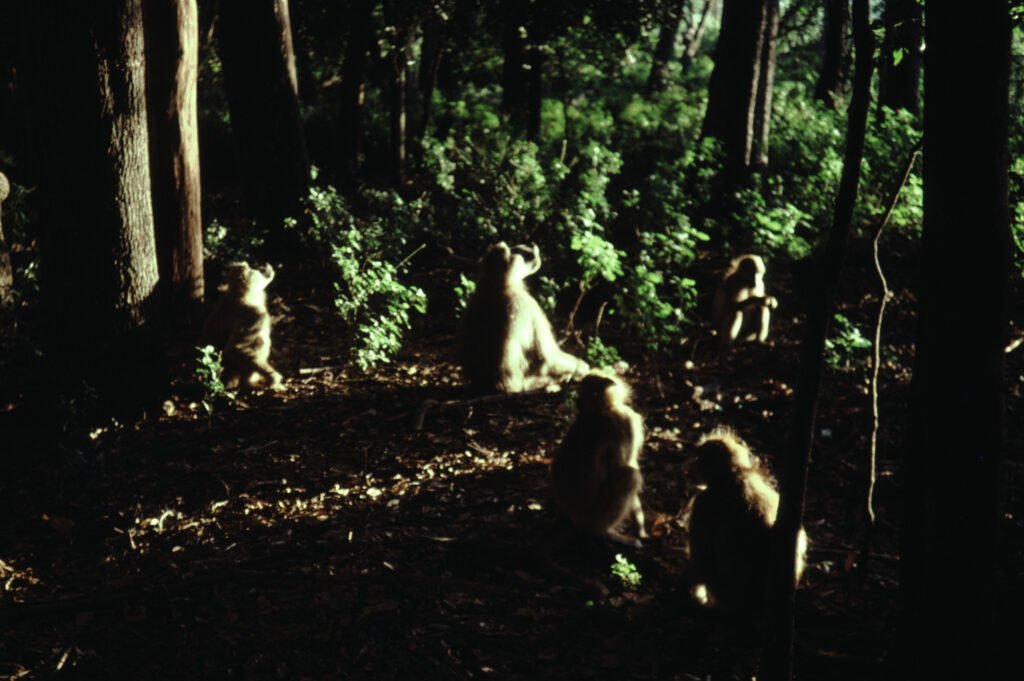
Baboons catch some early morning sun at the White Island roost. 
During 1979 and the first half of 1980, having become increasingly cavalier about the dangers of the bush, I slept at this roost at least 50 nights — arriving by Land Rover, by motorcycle, or even by foot when necessary. Unlike the typical baboon troop that often changes roosts from one night to the next, the 70+ members of the White Island (“W”) troop always slept at this roost. Perhaps they shared my fascination with the place, but more likely they felt just a bit safer there amidst the sprawling knobthorn trees.
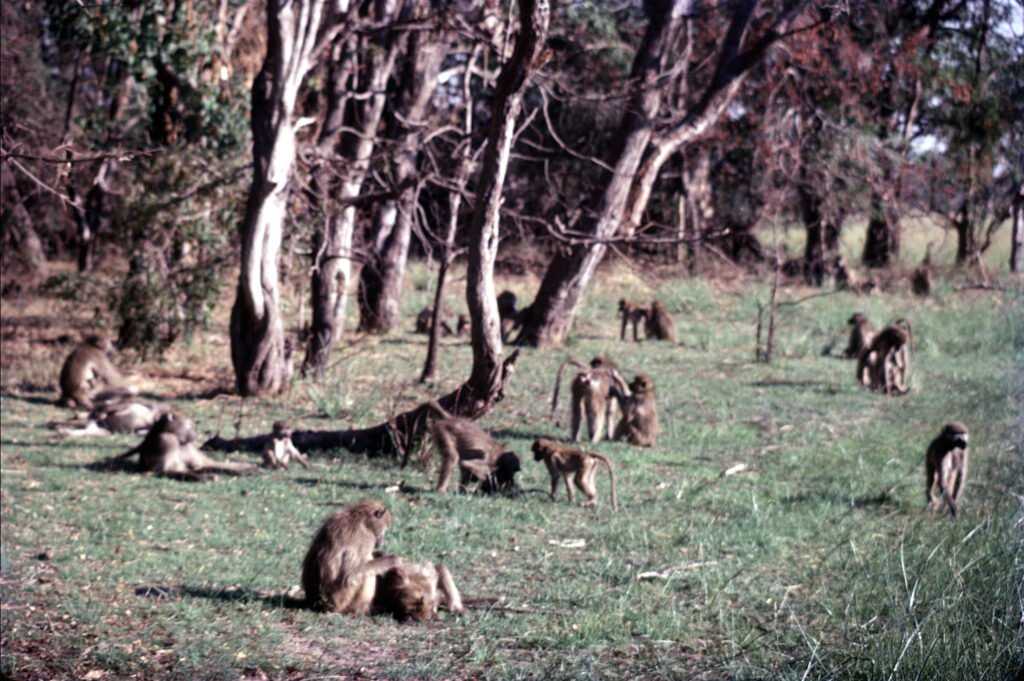
White Island baboons bask in the morning sun along a floodplain some 40 yards west of the roost.
I never sacrificed comfort when sleeping at the roost. My bed was a thin mattress with sheets, a pillow, and a blanket (when necessary), all enclosed in a protective mosquito net and placed on the ground next to the Land Rover (when available) under a gap in the canopy safe from falling fecal matter. I shared this site with a porcupine that often woke me up in the middle of the night while rummaging nearby and rattling its quills. The nights spent under the stars watching the silhouettes of the baboons above me and listening to the lions and hyenas in the distance were unforgettable.
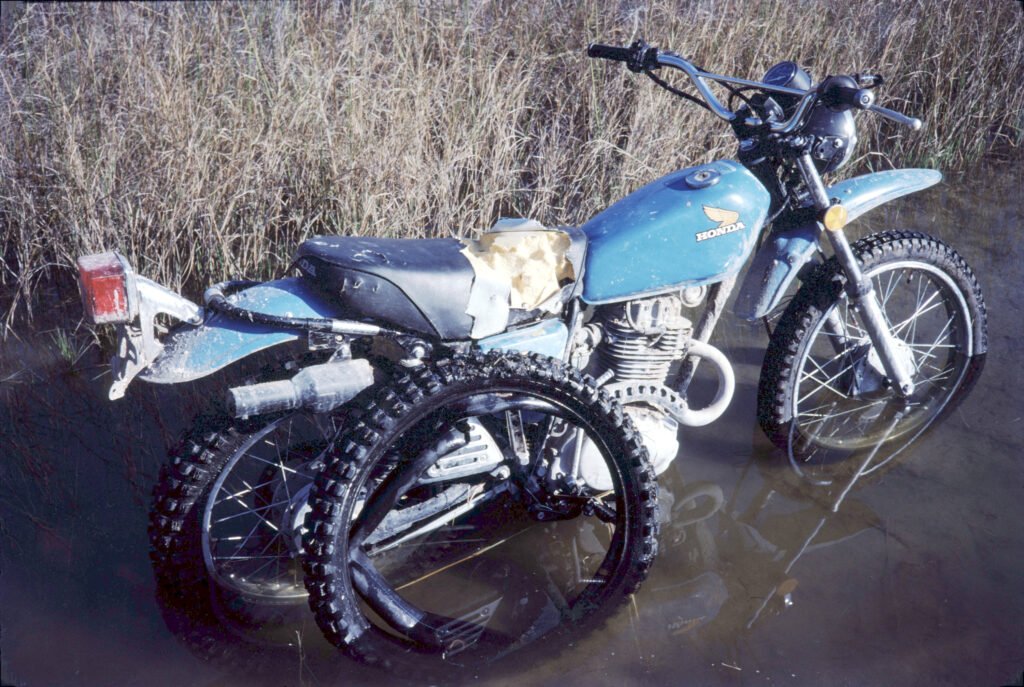
One night, a hyena chewed up part of the seat and a tire of our Honda XL175 dirt bike, which lasted for almost a year.
During three of those nights leopards attacked the baboons. Another evening three lions came prowling below the roost at dusk and pinned me up a tree for twenty minutes. That sobbering experience renewed my respect for the bush but did not deter me from returning to sleep at the roost.
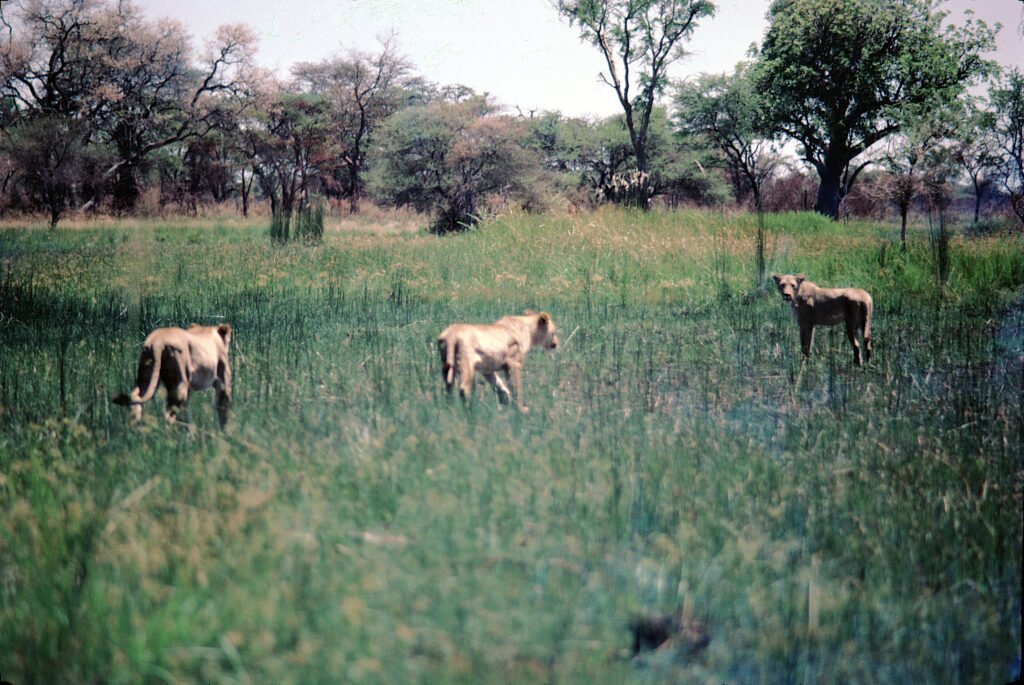
We saw these three lionesses — one adult and two almost fully grown — several dozen times during the three year study, often when we were watching the baboons on foot. One evening they showed up at the White Island baboon roost at dusk and trapped me up a tree for twenty minutes.
By early 1980 I had witnessed a decent number of lion and leopard attacks, not merely at the White Island roost. Camp troop and two nearby troops, X and Z, also came under attack by leopards at night. I managed to drag myself out of bed in the middle of the night more than once to drive out and investigate a leopard-induced commotion. The conventional wisdom at the time was that leopards were the principle enemy of baboons throughout Africa, yet direct evidence was surprisingly limited.
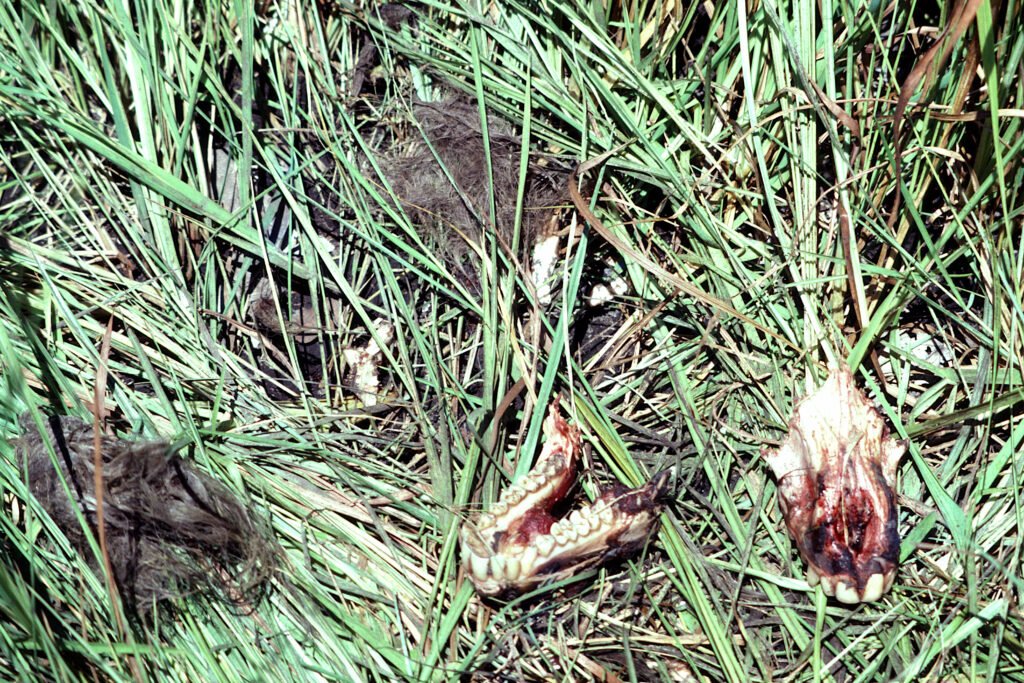
These are the remains of an adult male baboon in Camp Troop killed by the three lionesses. This predation occurred before we had incorporated Camp Troop into our study.
During a visit to Gaborone, Botswana’s capital, I had the pleasure of meeting Alec Campbell, who had served as Botswana’s Wildlife Director before becoming director of the National Museum and Art Gallery. Alec gave me a tour of the modest yet exceptional museum and introduced me to their journal, Botswana Notes and Records, a publication of unexpected quality that included articles on all aspects of Botswana art, culture, history, and social and natural sciences. Alec was intrigued by my stories of the Okavango and he encouraged me to submit an article.
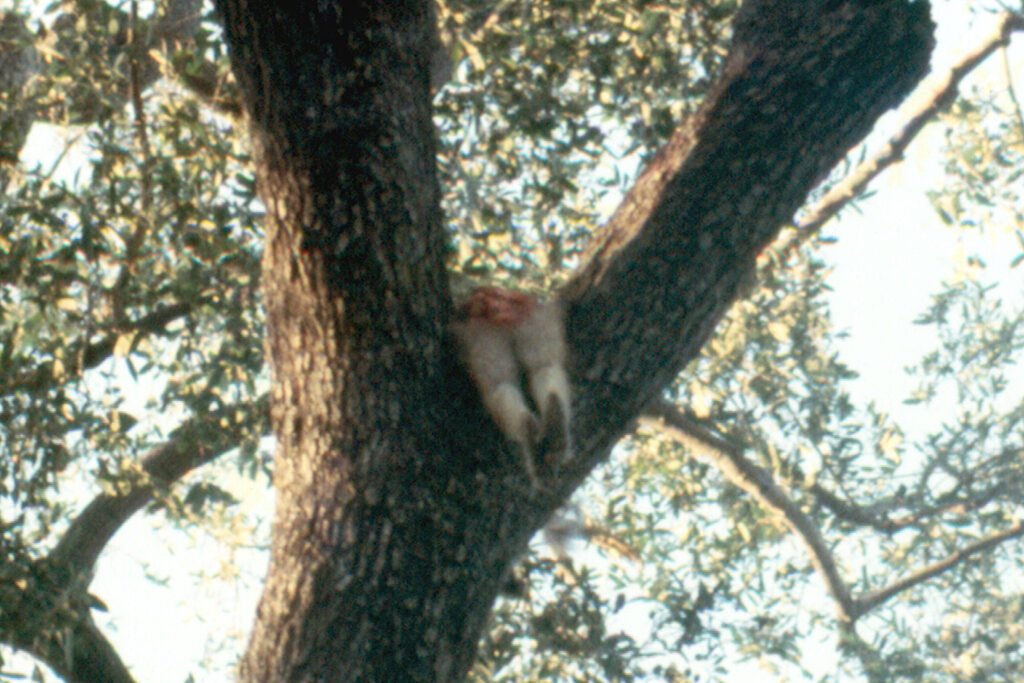
A leopard killed this adult female baboon before sunrise on August 14, 1978. The leopard fled from observers, but returned later to consume the kill.
Although I did not realize it at the time, the manuscript that I sent to Alec would become the first ever publication dedicated to predation on any primate by large carnivores. In 2004, Dorothy Cheney, Robert Seyfarth and their team, reporting on 10 years of observations of the Camp Troop baboons (see here), confirmed and extended these earlier findings that leopards and lions are the main causes of mortality for adult baboons in the Okavango.
Observations of the White Island troop ended in the 1980’s as the research effort focused on the more accessible Camp Troop. But I’ll bet that if I have the good fortune of visiting the Okavango some day, I’ll find the descendants of the White Island baboons roosting in that same grove of trees that gave me so many great memories.
Curt Busse,
July, 2004