
Do Chimpanzees Hunt Cooperatively?
Evidence from 64 Hunts at Gombe
In the early 1970s, many scientists believed that chimpanzees hunted cooperatively and that meat primarily served social functions. During 1973 and 1974, however, the Gombe research team recorded an increasing number of successful hunts by solitary males. Drawing on 64 observed hunts by chimpanzee groups and solitary individuals, the 1978 publication “Do chimpanzees hunt cooperatively?” (this page, bottom) was the first report of wild chimpanzees successfully hunting red colobus monkeys entirely on their own.
Historical Context
In 1973, Geza Teleki published the landmark book The Predatory Behavior of Wild Chimpanzees, the first comprehensive study of chimpanzee hunting at Gombe. Based largely on observations of chimpanzees hunting young baboons near the banana-provisioning station, together with earlier observations by Jane Goodall, the book reinforced the prevailing view that chimpanzees hunted cooperatively by joining forces to corner prey and block escape routes.1
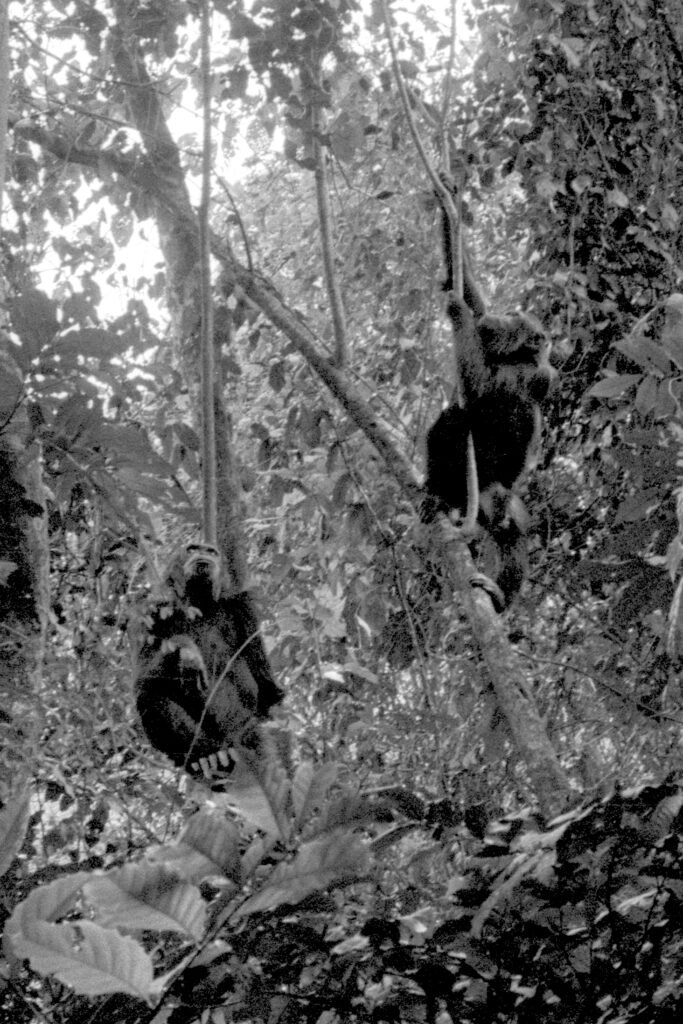
Two females, Madam Bee and her daughter Little Bee2 (climbing), watch colobus monkeys in the forest canopy during an unsuccessful group hunt on August 26, 1974. Most hunting was by males, but there were exceptions. 
At the same time, scientists were debating why chimpanzees hunted and ate meat. While meat likely provided valuable nutrients, some researchers argued that hunting and the sharing of meat served important social functions. Teleki (1973), in particular, suggested that successful hunting and possession of meat could enhance a young male’s social status, noting that “meat is usually eaten and shared in a leisurely manner more suggestive of pleasure than basic hunger alone” (p. 173).
Red Colobus Monkeys take the Spotlight
As researchers followed chimpanzees away from the banana-feeding area and into the forest, it became clear that their principal prey was not baboons but red colobus monkeys.3 Although chimpanzees usually hunted in groups, field observations increasingly revealed the competitive nature of meat-eating. Individuals often tried to keep a carcass for themselves, fled with their kills, or lost them to older or more dominant chimpanzees.4
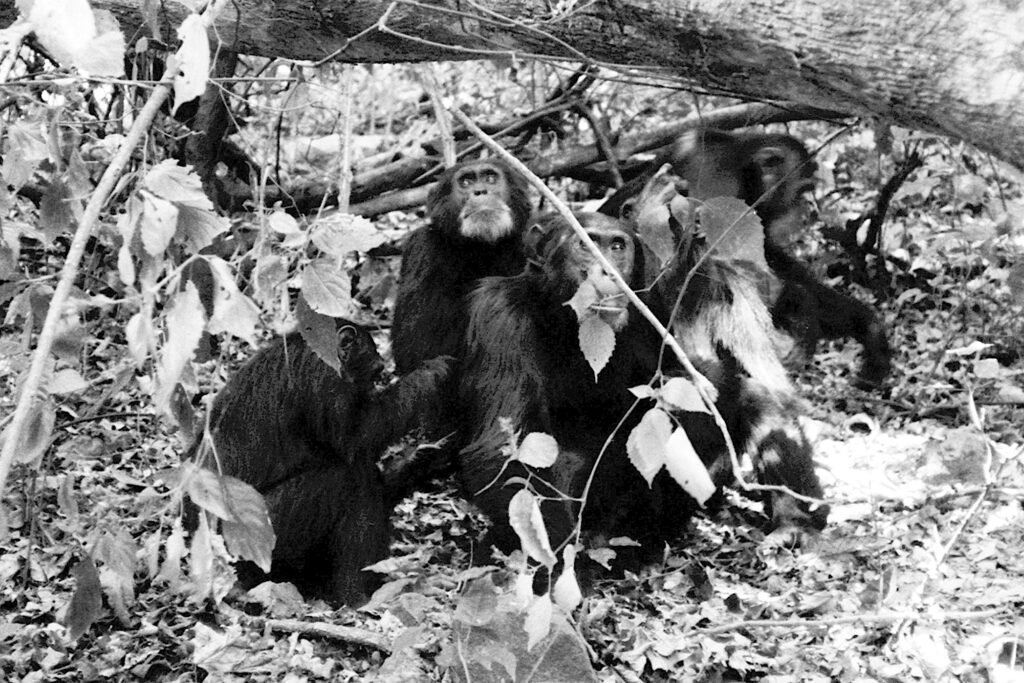
Charlie and Willy Wally watch colobus monkeys in the treetops during an unsuccessful group hunt on August 26, 1974.
When I arrived at Gombe in January 1974, researchers had already documented several dozen hunts of red colobus monkeys. During the next eight months I witnessed fifteen hunts, including nine kills. By the time I left Gombe, I had come to view chimpanzee hunting as a story of competition as much as cooperation.
The Study
Jane Goodall very graciously allowed me to publish two short papers based on the Gombe predation reports from 1973 and 1974, a period during which observations of chimpanzee hunting expanded rapidly. The data analyzed in this paper came from an experienced team of fifteen Tanzanian field assistants and thirteen foreign researchers, whose combined observations formed the largest published data set on chimpanzee hunting available at the time.5
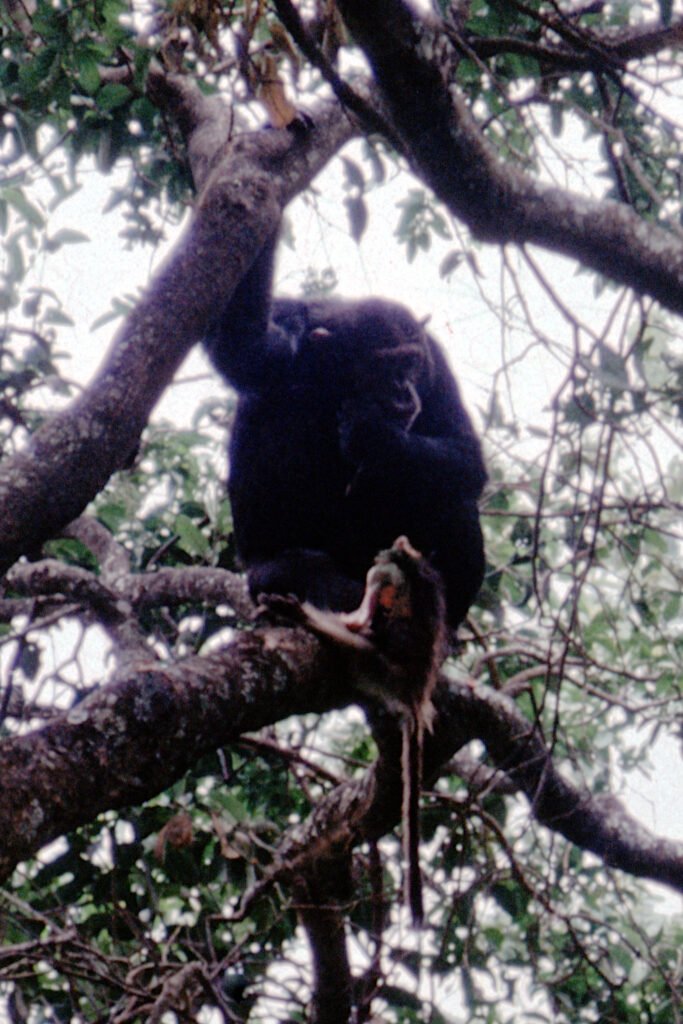
Sniff eats a colobus monkey that he captured on July 10, 1974. This is the first photo of a chimpanzee eating a monkey that he captured while hunting alone. Sniff slowly consumed the carcass over a 3 ½ hour period.
Key findings
Male chimpanzees sometimes hunted alone.
Nineteen hunts involved a single adult male (or a male accompanied only by nonparticipating females). Six were successful.
Solitary hunters did not advertise their success.
Twice, lone males (Figan and Sniff) captured, killed, and consumed an entire red colobus monkey by themselves. They remained silent, making no attempt to attract other chimpanzees.6
Larger hunting parties were more likely to make a kill.
Groups succeeded in 56% of hunts compared with 32% for solitary males, although the difference did not reach statistical significance.
Individual success declined as hunting groups became larger.
Although larger groups were more likely to make at least one kill, the probability that any one chimpanzee would make a kill actually declined as group size increased (Figure 1).
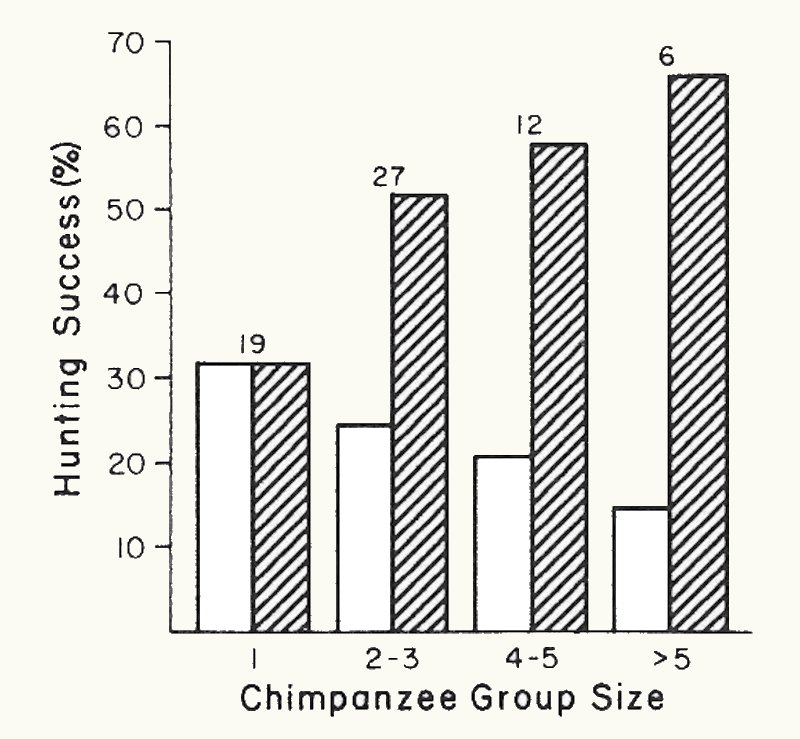
Figure 1 shows hunting success (%) vs. group size (hatched bars). Numbers above the hatched bars show the number of hunts. Open bars show the success for individual participants. © The University of Chicago Press.
Competition for meat could be intense.
Ten times, a successful hunter immediately fled with his kill, apparently trying to avoid other chimpanzees (see the story of “Six chimpanzees, three monkeys, one afternoon at Gombe”). Those that stayed sometimes lost the carcass. An old, low-ranking male named Mike seized the kill at all five hunts he attended.
Hunting sometimes continued after a kill was made.
Rather than stopping to compete for meat after the first kill, some chimpanzees continued hunting. On five occasions, more than one monkey was killed.
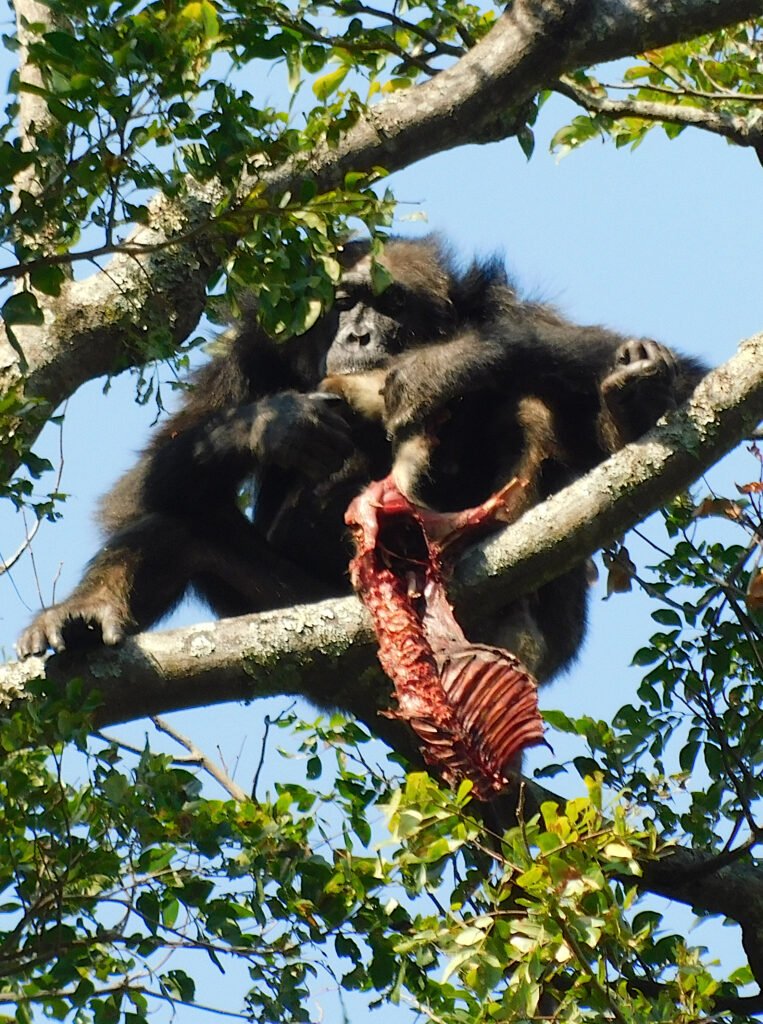
In a truly remarkable coincidence, I saw adult male Sheldon eating a colobus monkey all alone during my first visit to Gombe in fifty years. How Sheldon acquired the monkey was not known — but he must have staged this just for me 
Why This Paper Mattered
The observations summarized here revealed that some adult males could successfully hunt red colobus monkeys on their own, that solitary hunters did not recruit others to share the spoils, and that hunters often fled with their catch.
Taken together, these findings challenged two prevailing ideas of the time: that chimpanzee hunting for monkeys relied on collective action and that meat-eating was driven primarily by social rather than nutritional factors.7
Over the years, the science and our understanding have continued to evolve, yet those moments in the field watching skilled hunters like Sniff and Figan remain as vivid and significant today as they were in 1974.
Curt Busse
July, 2026
Original Publication
Below is the complete four-page letter to the editor exactly as published in The American Naturalist in 1978. Presented courtesy of The University of Chicago Press.
Busse, C. D. 1978. Do Chimpanzees Hunt Cooperatively? The American Naturalist 112:767–770. © The University of Chicago Press.
Sources and Further Reading
Teleki, G. (1973). The Predatory Behavior of Wild Chimpanzees. Lewisburg, PA: Bucknell University Press.
Wrangham, R.W. (1975). The Behavioural Ecology of Chimpanzees in Gombe National Park, Tanzania. Ph.D. dissertation, University of Cambridge.
Hamilton, W. J., III, & Busse, C. D. (1978). Primate carnivory and its significance to human diets. BioScience, 28(12), 761–766.
Goodall, J. (1986). The Chimpanzees of Gombe: Patterns of Behavior. Cambridge, MA: The Belknap Press of Harvard University Press.
Stanford, C. B. (1998). Chimpanzee and Red Colobus: The Ecology of Predator and Prey. Cambridge, MA: Harvard University Press.
Gilby, I. C., Eberly, L. E., Pintea, L., & Pusey, A. E. (2006). Ecological and social influences on the hunting behaviour of wild chimpanzees (Pan troglodytes schweinfurthii). Animal Behaviour, 72, 169–180.
- Teleki (1973, pp. 173-174) reported that, as of August 1970, a solitary chimpanzee had not yet been observed to pursue, capture, and consume a prey, and suggested that “it may seem reasonable to assume that predatory capability is somehow related to collective action.“
↩︎ - Madam Bee lost the use of her left arm during the 1966 polio epidemic. Little Bee was born with a deformed right foot, probably a club foot (Goodall, 1986).
↩︎ - Wrangham (1975).
↩︎ - Wrangham (1975, Table 4.12) found that access to meat followed a linear hierarchy among males. Hugo and Mike, the two oldest males, were the most successful at obtaining meat from other males.
↩︎ - Jane’s team members who observed chimpanzees hunting red colobys monkeys during 1973 and 1974 included Rugema Bambanganya, Adriano Bandora, Hassani Bitura, Curt Busse, Cretus Chiwaga, John Crocker, Larry Goldman, Hank Klein, Mark Leighton, Petro Leo, Hamisi Matama, Hilali Matama, Bill McGrew, Hamisi Mkono, Juma Mkukwe, Esilom Mpongo, Rweyongeza Mwenera, Yahaya Ntabilio, Ann Pierce, David Riss, Penny Rucks, Njuma Rukamata, Kassim Selemani, Yassini Selemani, Sara Simpson, Caroline Tutin, Emilie van Zinnicq Bergmann, and Richard Wrangham.
↩︎ - While observing baboons in April 1973, Anthony Collins and Emilie van Zinnicq Bergmann saw adult male chimpanzee Satan kill two piglets while all alone. Satan quietly consumed them both over a 3 ½ hour period until the observation ended (Gombe predation file and Wrangham, 1975, page 4.37).
↩︎ - Reviewed by Wrangham (1975), Hamilton and Busse (1978).
↩︎