
Six Chimpanzees, Three Monkeys, One Afternoon at Gombe
A Lesson in Chimpanzee Hunting
On the afternoon of March 19, 1974, I struggled through the dense forest of the upper Mkenke valley, unable to keep up with Yahaya Ntabilio and the six chimpanzees we were following. When I finally caught up with them beside the stream, all six sat silently, staring into the canopy.
Somewhere above us, hidden sixty to eighty feet overhead, red colobus monkeys barked alarm calls as branches crashed and leaves shook.
In less than twenty minutes, three monkeys would be dead.
It was only the second reported case of chimpanzees killing more than one monkey in a single hunt.1 2 Even more surprising was what two of the three captors did with their kills.
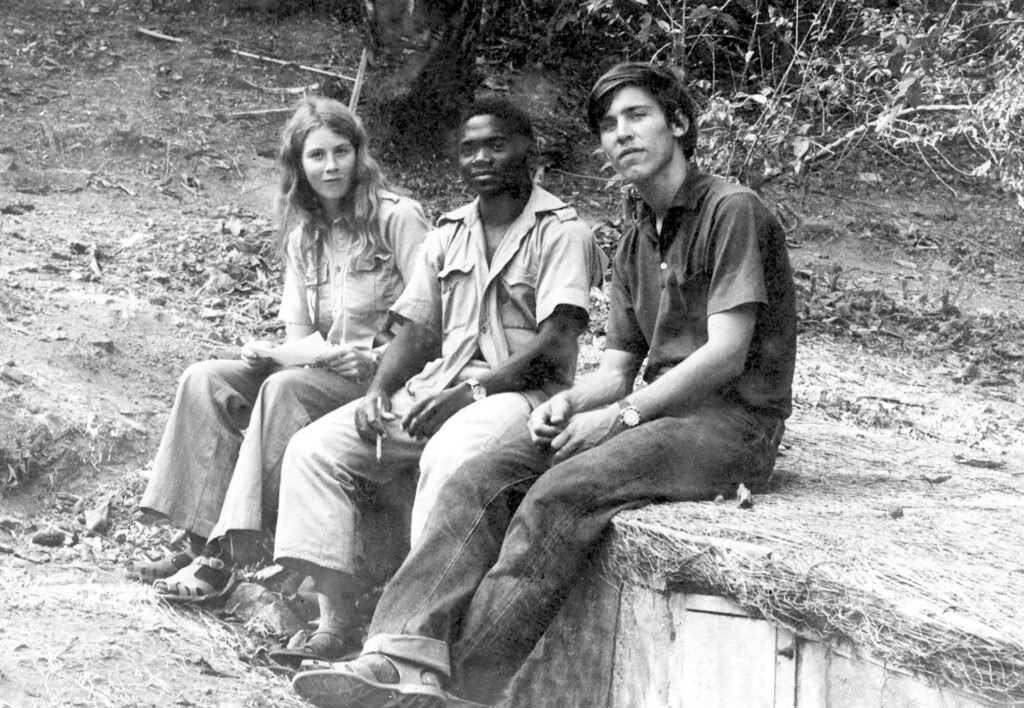
Caroline Tutin, Yahaya Ntabilio, and David Riss, 1973 (photo by Emilie van Zinnicq Bergmann-Riss).
Red Colobus Monkeys Take Center Stage
On October 30, 1960, Jane Goodall watched a male chimpanzee she later named David Graybeard eating fresh meat from the carcass of a young bushpig. The observation upended the prevailing scientific belief that chimpanzees were essentially vegetarians. Only five days later, David Graybeard surprised her again, this time by inserting a grass stem into the ground to extract termites.3
Over the following decade, Jane and her team learned that although meat made up only a tiny portion of the chimpanzees’ predominantly fruit diet, it was one of their favorite foods. Researchers saw chimpanzees opportunistically kill piglets and bushbuck fawns, and actively hunt young baboons near the banana-provisioning station.4
During group hunts for baboons and other monkeys, the chimpanzees sometimes appeared to coordinate their efforts, particularly by blocking the prey’s escape routes. Jane described this cautiously, calling it “the beginning of cooperative endeavor.”5
She also found that whoever ended up with the carcass would often share meat with others, even if it amounted to little more than scraps.
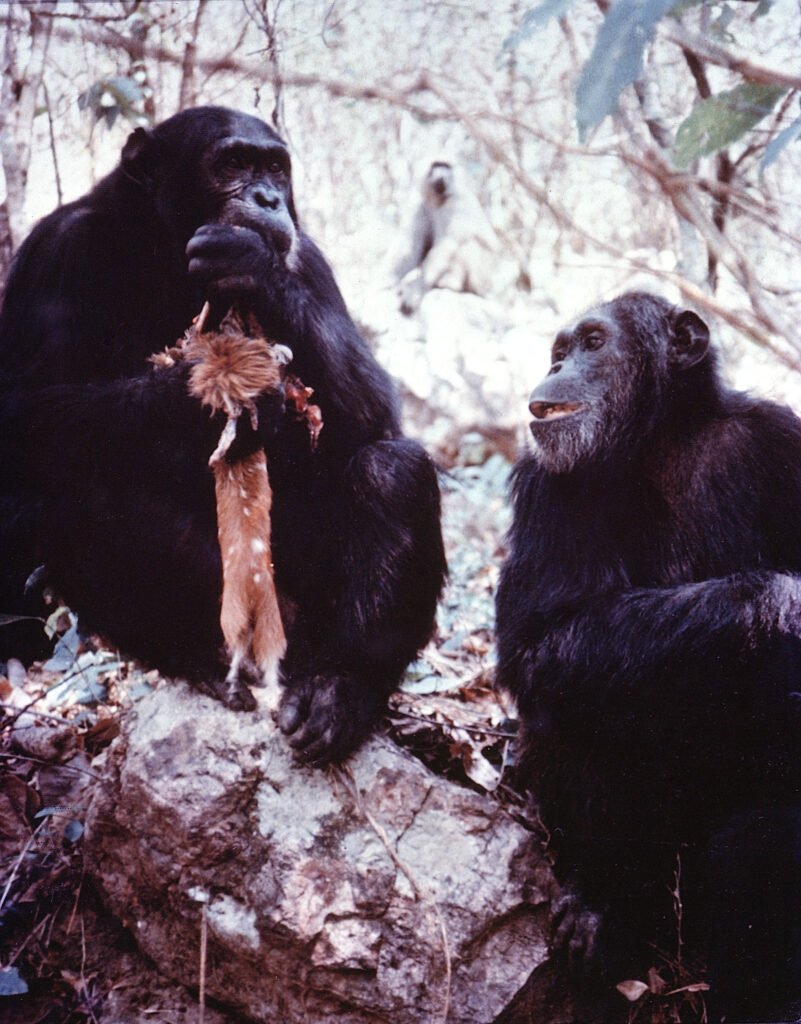
Gigi feeds from the remains of a bushbuck fawn stolen from baboons (background).6 I saw old Mike (right) at four kills; this was the only time he failed to take control of the carcass. 
A major shift in our understanding of chimpanzee hunting at Gombe came in the early 1970s. Banana provisioning had been drastically reduced. The team of local staff and foreign students increasingly followed chimpanzees away from the feeding station and into the forest. There, they discovered that the chimpanzees’ main prey wasn’t baboons but red colobus monkeys.7
These monkeys lived high in the forest canopy, typically in groups of thirty to fifty individuals, including several adult males. Hunting them took real skill: chimpanzees had to chase lighter, more agile prey through the treetops, all while risking falls and counterattacks from protective male monkeys.
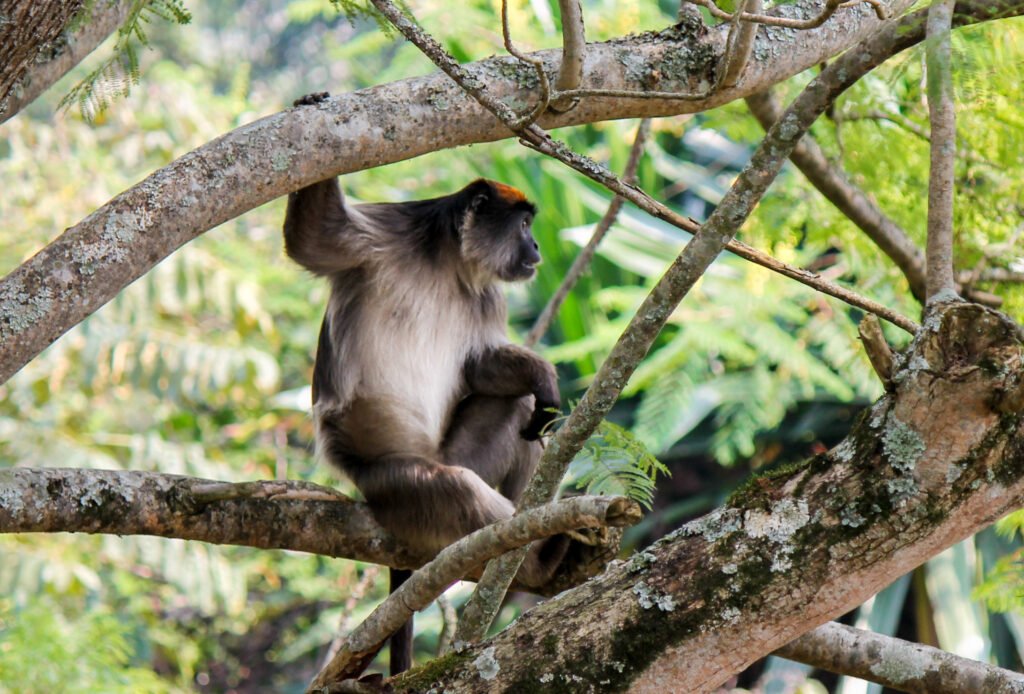
Adult male red colobus monkeys could be quite fierce, or in Swahili “kali sana.”(Shutterstock/Robin Nieuwenkamp).8 9
During 1973 and 1974, David Riss and I saw chimpanzees at Gombe hunt red colobus monkeys twenty-four times.10 Eleven of those hunts succeeded (46%), for a total of fourteen kills.
Most of these hunts involved two or more males. Typically, if a monkey had been caught, the chimpanzees’ attention shifted immediately to the carcass, as others begged, competed, and sometimes fought for a share.
But not always.
March 19, 1974
On this day, Yahaya and I were following Humphrey, who met up with five other adult males: Evered, Figan, Satan, Jomeo, and Sherry.11
By early afternoon, the group had entered a densely forested stretch of the upper Mkenke valley, about a hundred yards upstream from the tallest waterfall at Gombe (video, below).
The Mkenke waterfall is the tallest at Gombe — approximately 85 ft. high (July, 2024).
The frequent rains had left the understory thick and overgrown. While the chimpanzees and Yahaya moved through the tangled, thorny vegetation with ease, I was still learning the ropes and quickly fell behind.
I found all six chimpanzees sitting beside the stream and staring up into the canopy. Yahaya stood nearby. Only then did I register the sounds overhead: alarm barks, crashing branches, and movement high in the trees.12 13
“Chondi,” Yahaya said, using the local word for red colobus monkeys.14
I caught sight of monkeys running along branches and leaping through the treetops. The chimpanzees watched for several minutes. Then everything exploded.
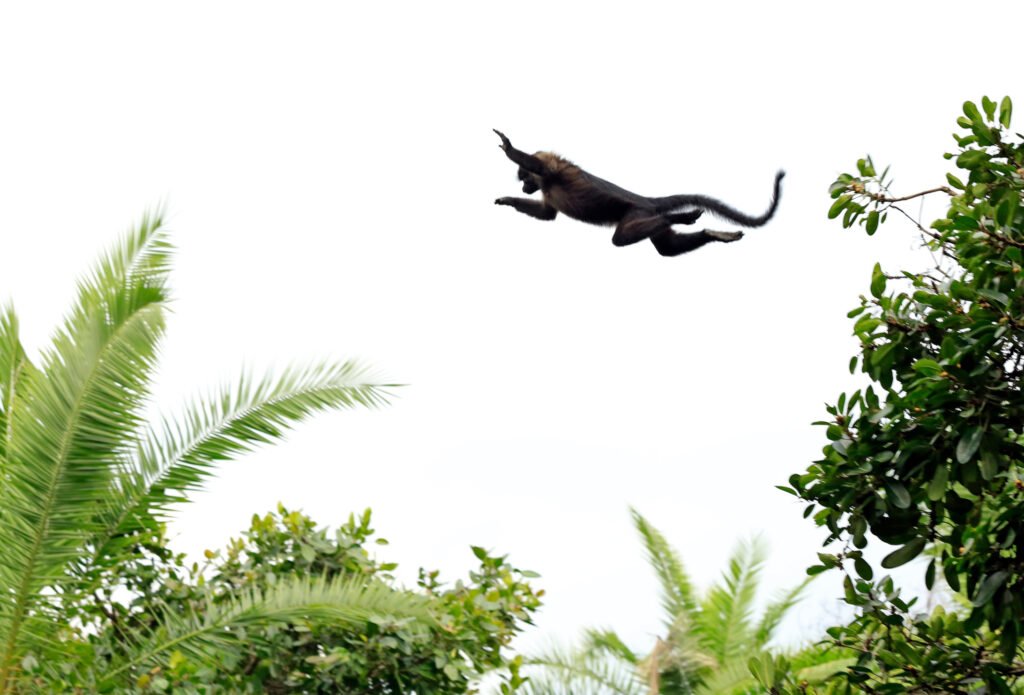
Red colobus monkey leaping in Uganda. (Shutterstock/Daniel Lamborn)
Humphrey, Figan, and Satan rushed downslope along the stream and climbed into the trees. Yahaya hurried off in that direction, but once again I got held up in vines and lost track of him. Fortunately for me, Evered and the brothers Jomeo and Sherry had stayed behind.
Ahead of me, hidden by vegetation, came the sounds of chaos. I briefly saw Figan charging along the ground, shaking branches before disappearing from view. A few minutes later Yahaya returned with exciting news. He had seen Figan carrying a small piece of fresh meat and suspected that Humphrey had already made a kill, though he wasn’t certain.
At that moment, our attention shifted to far overhead. Sherry raced along a branch, chasing a mother carrying an infant on her belly. After a brief pursuit, the monkeys leapt to safety.
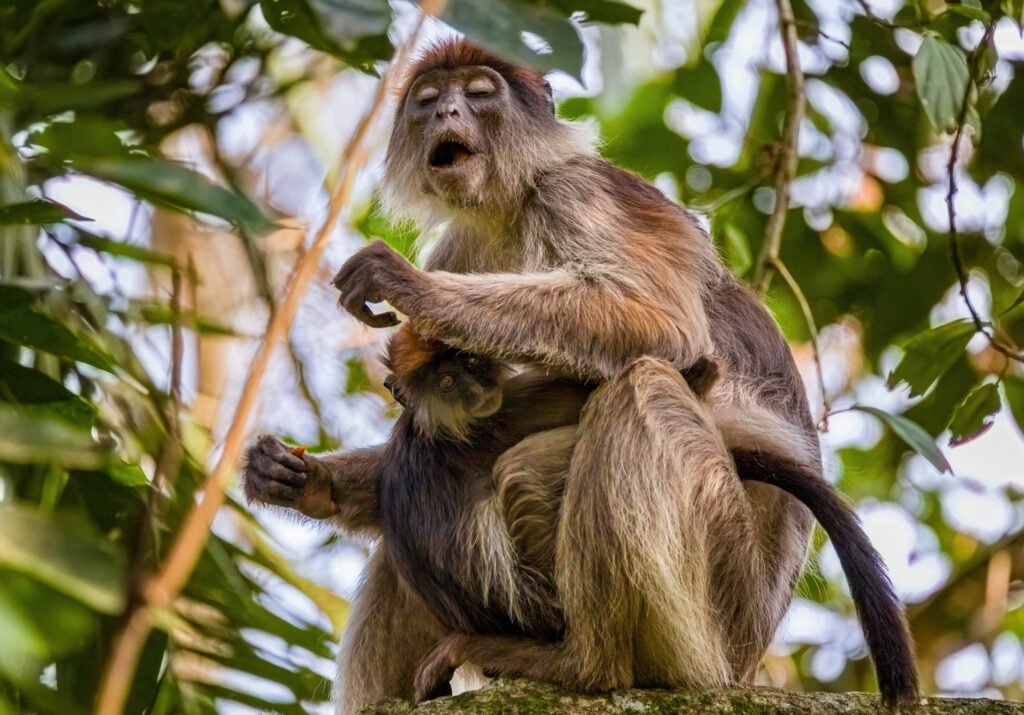
Mother and infant red colobus monkeys in Uganda. (Adobe Stock/Sascha)
Meanwhile, Evered and Jomeo remained below, watching. Then, with Sherry still in the canopy, the two larger males climbed up adjacent trees. Evered chased a different mother-infant pair but couldn’t close the distance.
For several minutes all I could make out were fleeting glimpses of chimpanzees through the understory, punctuated by monkey barks and crashing branches overhead.
Then Evered came into view running along a thick branch just as he caught up to a mother, who bit him on the wrist. Evered screamed, tore the infant from her belly, and vanished into the foliage with his prize.
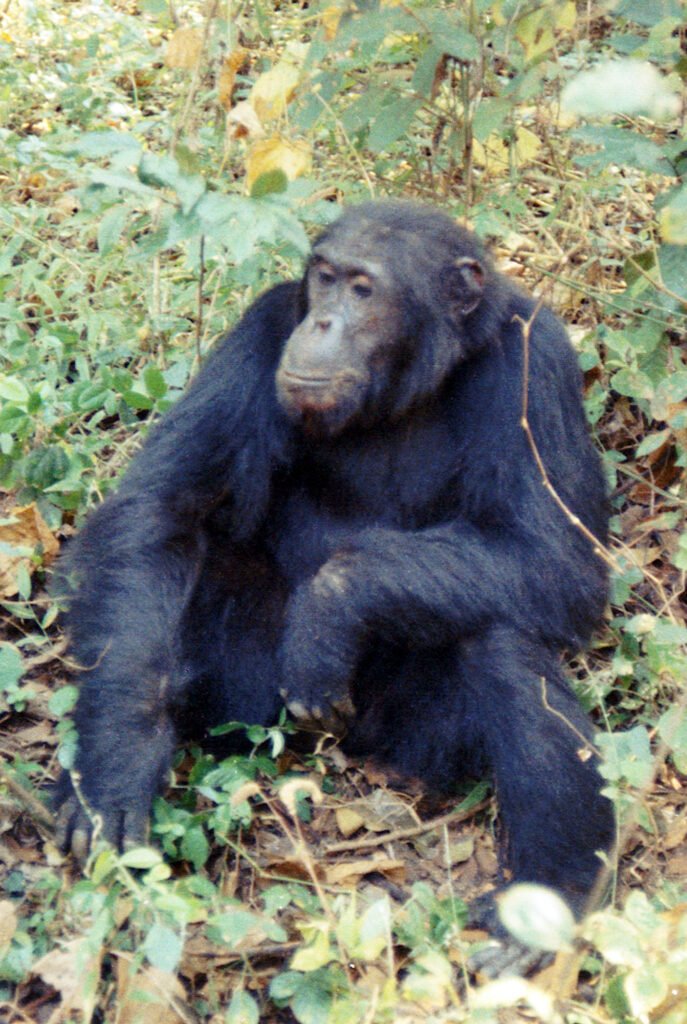
Evered
Barely a minute later came another commotion. Out of nowhere, a juvenile-sized monkey landed on the ground only a short distance from Yahaya and me — with Jomeo in hot pursuit. The monkey ran maybe ten feet before freezing. Jomeo scooped it up and disappeared uphill, not to be seen again that day.
Soon after, Evered emerged with the lifeless infant monkey in his mouth. He walked right past us and continued upstream, away from where Humphrey had gone.15
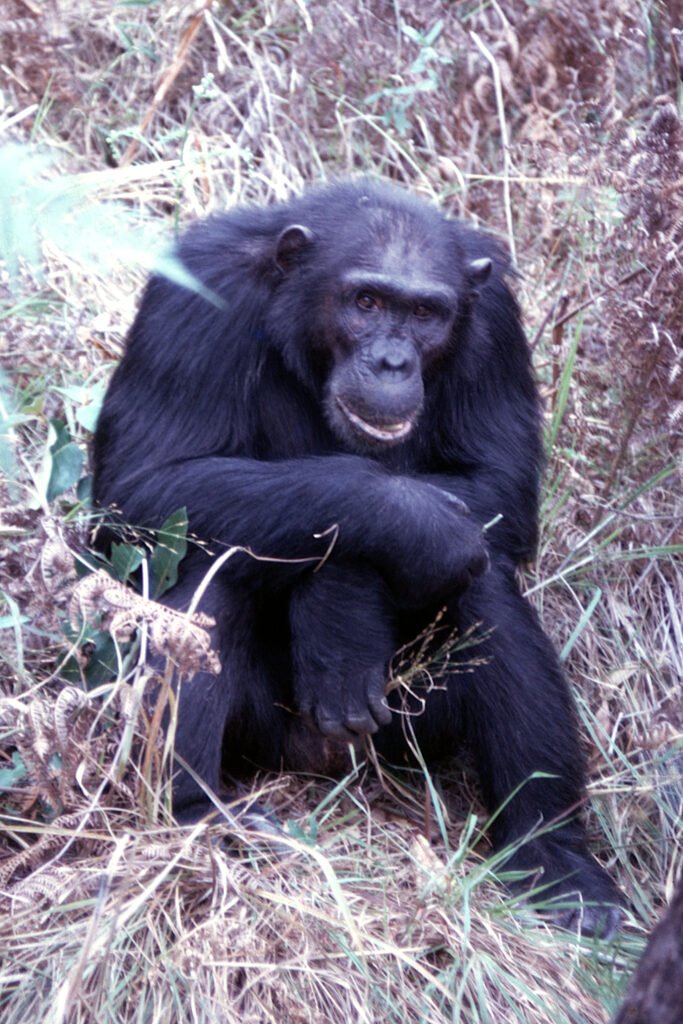
Jomeo
Sherry followed and begged for meat, but Evered ignored him. Within minutes, Sherry had gone back to hunting. He gave up soon and headed down toward the waterfall where we found Humphrey sitting in a tree eating a juvenile monkey.16
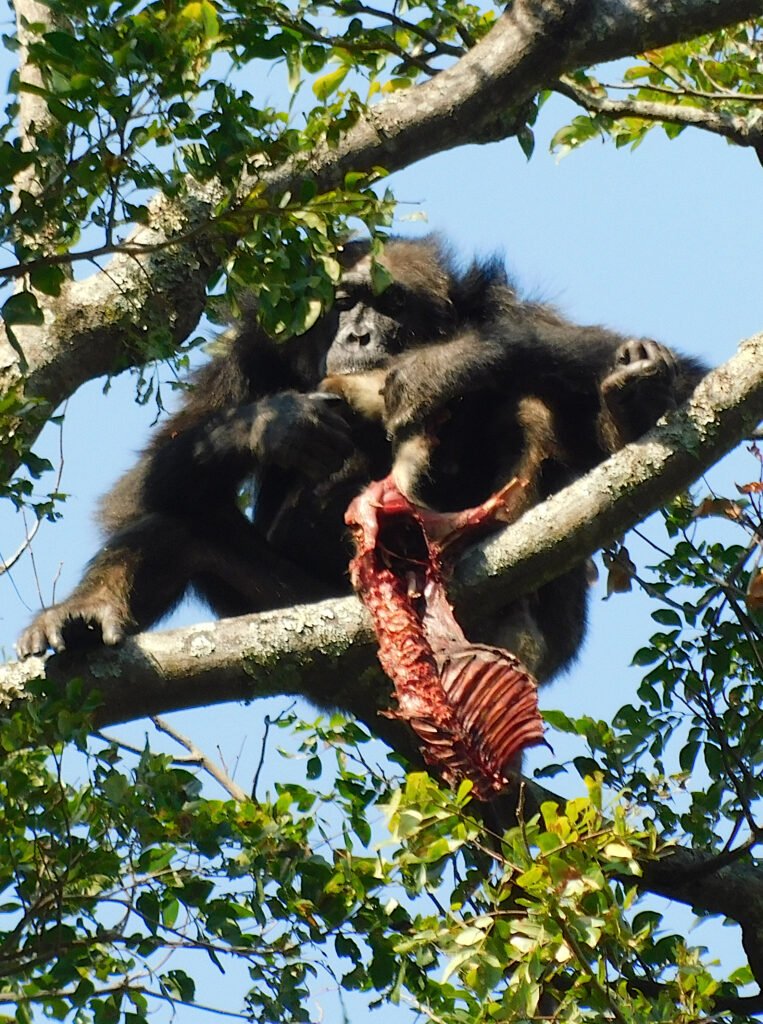
Adult male Sheldon with the remains of an adult colobus monkey at Gombe in 2024.17
Nearby were Figan, Goblin, Patti, Athena, Atlas, and Dove. Some possessed scraps of meat, while others squeaked, screamed, and begged persistently for a share. Their racket attracted still more chimpanzees. Two hours later, almost the entire carcass was gone, most of it eaten by Humphrey.
What March 19 Revealed to Me
First, chimpanzee hunting could be extraordinarily hard to observe. Even an experienced tracker like Yahaya sometimes missed key moments, such as Humphrey’s capture of the first monkey.
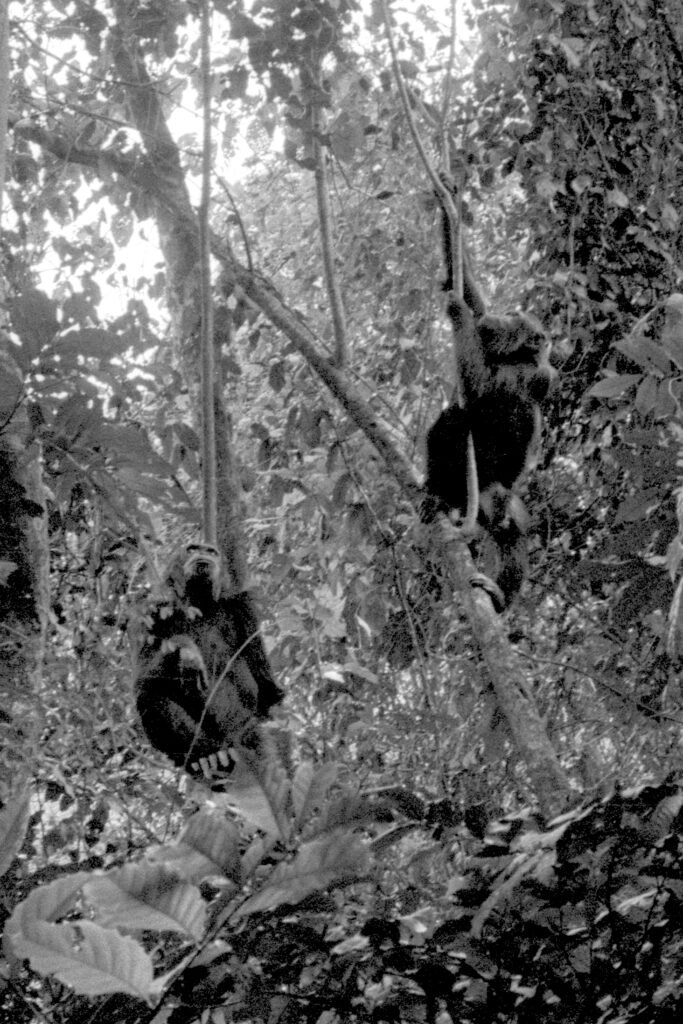
The females Madam Bee and Little Bee (climbing) watch colobus monkeys during a prolonged unsuccessful hunt by the Kahama community chimps on August 26, 1974. Arboreal hunting is largely a male activity — but not always.18 19
Second, group hunting didn’t necessarily mean teamwork. Were Evered, Jomeo, and Sherry deliberately coordinating their efforts by cutting off escape routes and driving monkeys toward one another? Or were they simply hunting side by side, each taking advantage of the confusion created by multiple simultaneous points of attack? From our obscured view on the forest floor, we couldn’t say for sure.
Third, a successful kill did not necessarily end the hunt. If Evered and Jomeo knew that Humphrey had already secured a monkey, they nevertheless chose to continue hunting rather than seek meat from him.20 Later, Sherry kept hunting after Evered turned him away empty-handed.
This was different from most prior observations in which chimpanzees stopped hunting and converged on a carcass once a kill had been made. Observers invariably focused their attention on activities around the carcass as well. Had I stayed with Humphrey, rather than lagging behind with Evered and Jomeo, the latter two kills probably would have gone unnoticed.
Finally, after making a kill, chimpanzees attempted to avoid the attention of others so far as possible.21 Humphrey shared some of his carcass, but guarded it closely and ate most of it himself. More telling still were Evered and Jomeo, each disappearing with his kill and showing no interest in sharing.
Hunting Alone
Male chimpanzees at Gombe spent much of their time in groups, foraging and participating in social activities unrelated to hunting. When a group happened upon a colobus troop, they hunted about half of the time. But the chimpanzees also spent some of their time alone. What would happen when a solitary chimpanzee encountered colobus monkeys? 22
Just a week after the events of March 19th, Yahaya and Yassini Selemani watched Figan hunt and kill a red colobus monkey entirely on his own. He ate the whole thing by himself without trying to recruit anyone else.
Yahaya and I saw the same thing happen on July 10th, when Sniff successfully hunted a colobus monkey alone and quietly ate the meat over several hours.
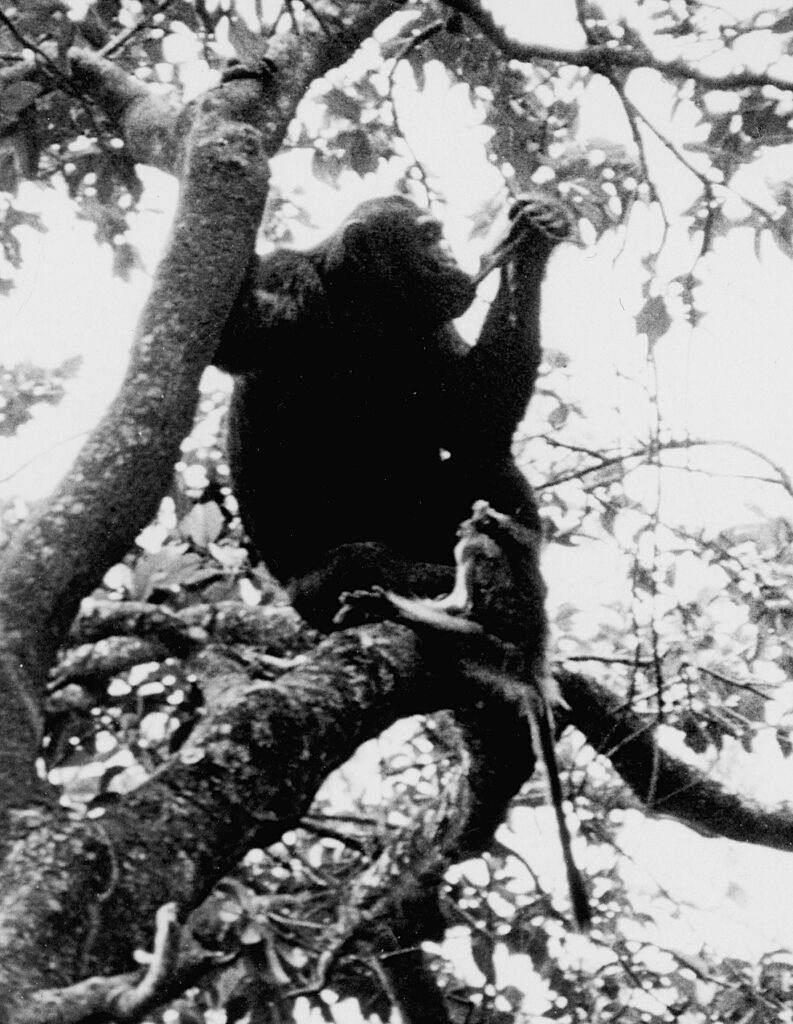
Sniff slowly and quietly eats a colobus monkey that he caught while hunting alone on July 10, 1974.
These and other cases showed that, at least for some individuals, group hunting wasn’t required for success. 23 24
And when a solitary hunter succeeded, he didn’t advertise his good fortune.25
Conclusion
Chimpanzees predominantly hunted in groups for red colobus monkeys, but how much they deliberately coordinated was hard to pin down. Observers on the forest floor rarely had a clear view of what was happening in three-dimensions in the canopy above.
By the time I left Gombe, I had come to appreciate that chimpanzee hunting followed no simple script: each hunt had its own course and cast of characters. Yet the image that has stayed with me for more than fifty years is that of Evered and Jomeo catching those two monkeys and slipping away into the forest with them.
Curt Busse
June, 2026
Google Earth video showing the location of the March 19, 1974 hunt. Generated from satellite images taken on June 9, 2025, the video provides a reasonable approximation of the landscape and vegetation as I remember them more than fifty years earlier.
Sources and Further Reading
van Lawick-Goodall, J. (1971). In the Shadow of Man. Boston: Houghton Mifflin Company.
Teleki, G. (1973). The Predatory Behavior of Wild Chimpanzees. Lewisburg, PA: Bucknell University Press.
Wrangham, R.W. (1975). The Behavioural Ecology of Chimpanzees in Gombe National Park, Tanzania. Ph.D. dissertation, University of Cambridge.
Busse, C.D. (1978). Do Chimpanzees Hunt Cooperatively? The American Naturalist, 112(986), 767–770.
Goodall, J. (1986). The Chimpanzees of Gombe: Patterns of Behavior. Cambridge, MA: The Belknap Press of Harvard University Press.
Peterson, D. (2006). Jane Goodall: The Woman Who Redefined Man. Boston: Houghton Mifflin Company.
- The first reported instance of chimpanzees killing multiple colobus monkeys during a single hunt occurred on September 11, 1973. While watching a hunt by four Kahama males, Esilom Mpongo and Rweyongeza Mwenera saw Godi grab an infant from its mother’s belly. Godi shared some of the kill with Sniff. After resting, the group hunted again and Sniff snatched another infant. The mother remained nearby and was herself killed by Goliath with Charlie’s help (E. Mpongo, personal communication, and Wrangham 1975, page 4.13).
David Riss and Emilie van Zinnicq Bergmann observed a similar incident in July 1974 when both a mother and infant were killed.
↩︎ - On August 22, 1973, Juma Mkukwe and Hamisi Matama saw Sniff kill two colobus monkeys during separate hunts involving most of the Kahama males. After the first kill, Charlie immediately took the carcass from him. Two hours later, the group hunted again and Sniff was once more successful (Gombe predation file). A similar script played out on October 9, 1974. Among the staff and students, Sniff had a well-deserved reputation as an exceptionally skilled hunter.
↩︎ - van Lawick-Goodall (1971), Peterson (2006).
↩︎ - Teleki (1973).
↩︎ - van Lawick-Goodall (1971).
↩︎ - Photo is from Day 47 of the Figan Follow. See also the full predation report, and Goodall (1986, pages 307-308).
↩︎ - Wrangham (1975).
↩︎ - While several chimpanzees fed on fruit on the ground, Richard Wrangham witnessed an adult male colobus monkey launch itself six meters from a tree branch onto Jomeo’s head (Wrangham 1975, page 4.13).
↩︎ - While David Riss and Hamisi Matama were sitting near Figan, an adult male colobus monkey appeared on the ground seemingly out of nowhere. It strode within five meters of David, then shoved Figan before retreating into the trees (Day 27 of the Figan Follow).
↩︎ - We accumulated a total of 1,830 hours of observation, and we were each accompanied at all times by one of Jane’s thirteen Tanzanian field assistants. One of Jane’s most important decisions was to hire and train local Tanzanians as field observers. Their intimate knowledge of the chimpanzees and their detailed records of travel patterns, group composition, feeding behavior, and other daily activities were the foundation of Gombe’s long-term research program and produced some of its most important discoveries.
↩︎ - This was a Murderers’ Row of chimpanzee hunters, listed here in order of dominance rank:
1 — Figan (age 21)
2 — Evered (age 22)
3 — Humphrey (age 28)
5 — Satan (age 19)
6 — Jomeo (age 18)
7 — Sherry (age 14)
Not present at this hunt:
4 — Faben (age 27)
8 — Mike (age 36)
9 — Hugo, formerly Rodolf (age 38)
↩︎ - Wrangham (1975, plate 4.1) found that chimpanzees were more likely to hunt red colobus monkeys where the forest canopy was broken and provided fewer escape routes. He highlighted the importance of emergent trees, especially Albizia gummifera, whose sturdy branches gave chimpanzees an advantage over the more agile monkeys.
↩︎ - David Riss and my observations of chimpanzees hunting red colobus monkeys generally fit this pattern. We saw multiple hunts and kills in mixed woodland-forest with broken canopy. Unfortunately, during the chaos of March 19, I was paying more attention to the chimpanzees than to the trees and made no notes on the structure of the canopy or the presence of emergent trees.
↩︎ - The Gombe field staff consistently referred to red colobus monkeys as “chondi” in our conversations and their field notes. Anthony Collins believes the word derives from the local Ha language, in which chondi refers more generally to monkeys (plural “ivyondi“). Because red colobus were by far the most common monkeys (excluding baboons) encountered during follows at Gombe, the term appears to have acquired a more specific meaning among the field staff. Other species were identified using Swahili names, including “kima” for blue monkeys, “kima ya nkia nyekundu” for red-tailed monkeys, “tumbili” for vervet monkeys, and “nyani” for baboons. This mixture of Ha and Swahili terms reflects the distinctive field vocabulary that developed at Gombe.
↩︎ - Only three weeks earlier in nearby lower Mkenke valley, Adriano Bandora and Esilom Mpongo had watched this same trio — Evered, Jomeo, and Sherry — brutally attack the Kahama male Dé. It was the second attack of the “four-year war.” Two hours later, the three males were hunting red colobus monkeys, and Evered made a kill (Gombe predation file).
↩︎ - We could not rule out the possibility that Satan made the first kill and Humphrey then took possession of it. Roughly an hour after Sherry led us to Humphrey and the carcass, Satan reappeared carrying a bone.
↩︎ - In 2024, during my first visit to Gombe in 50 years, our guide Sixtus Kisarika Mushi was scanning the far side of Kakombe valley with his binoculars when he spotted a chimpanzee in a tree eating a monkey. We found Sheldon, a former alpha male, then 41 years old, feeding alone on a relatively large colobus monkey. We watched him for thirty minutes. During that time he made no vocalizations, and no other chimpanzees appeared.
↩︎ - Prior to June 17, 1974, all known kills of red colobus monkeys at Gombe had been made by males. On that day, David Riss and Esilom Mpongo were observing Evered, Satan, Sherry, and Goblin hunting colobus monkeys when a scream from nearby drew their attention to Gigi, who was holding a freshly killed infant monkey. Evered immediately seized the prey, and lost it later when Humphrey arrived (David Riss, personal communication and the Gombe predation file).
↩︎ - See Goodall (1986, pp. 304–312) for a detailed discussion of hunting by female chimpanzees. This photograph of Madam Bee and Little Bee during a hunt also appears on page 304 of that volume, although the chimpanzees are incorrectly identified there as Gigi and Miff.
↩︎ - Wrangham (1975, Table 4.12) found that access to meat followed a linear hierarchy among males. Hugo and Mike, the two oldest males, were the most successful at obtaining meat from other males, whereas Evered, Jomeo, and Satan ranked at the bottom. (Sherry was transitioning to adulthood and was not part of Wrangham’s analysis, but likely would have ranked below Satan.)
↩︎ - Wrangham (1975, page 4.37).
↩︎ - During the 50 consecutive days in which David Riss and I followed Figan, he spent 84% of his time with others and 16% alone. The average group size included 4 adults. When in a group, Figan encountered colobus troops twelve times, hunting five of those times and making three confirmed kills himself. When alone, Figan encountered colobus troops three times, hunting two of those times and making no kills.
↩︎ - The first reported instance of a chimpanzee hunting and killing a colobus monkey entirely on his own at Gombe occurred on November 16, 1973. Bill McGrew saw Satan seize an infant from its mother (for details, see here). Her screams apparently attracted nearby chimpanzees including Mike, who arrived soon afterward and siezed the carcass from Satan (Gombe predation file).
↩︎ - During 1973 and 1974, chimpanzees hunted colobus monkeys 19 times when the hunter was alone or with non-participating females (Busse, 1978). Six of these hunts were successful: one by Satan, one by Figan, and four by Sniff (Kahama community).
↩︎ - While observing baboons in April 1973, Anthony Collins and Emilie van Zinnicq Bergmann saw adult male chimpanzee Satan kill two piglets while all alone. Satan quietly consumed them both over a 3 ½ hour period until the observation ended (Gombe predation file and Wrangham, 1975, page 4.37).
↩︎