
When Science Goes Awry
Two-thirds of the way through my field study of chacma baboons in the Okavango Delta, my dissertation research was collapsing. To rescue the project, we began darting and immobilizing the study animals to collect blood samples and other physiological data. During one anesthetization, a mother lay unconscious while her infant was grabbed and killed by a recently arrived adult male. Two weeks later, I witnessed a related event that fundamentally changed how I understood chacma baboons — and sent my research in an entirely new direction.
A Failing Dissertation Project
In 1977, I began my dissertation research in a remote part of the Okavango Delta of Botswana. The three-year study of baboon diet and nutrition was directed by Professor William J. “Bill” Hamilton III of U.C. Davis.
I was joined in the field by fellow students Steve Smith and Barbara Kus. Together, we established a new camp and eventually gained the confidence of two troops of chacma baboons totaling roughly 140 animals. For two years I followed the baboons on foot through this pristine habitat, recording everything they ate.1
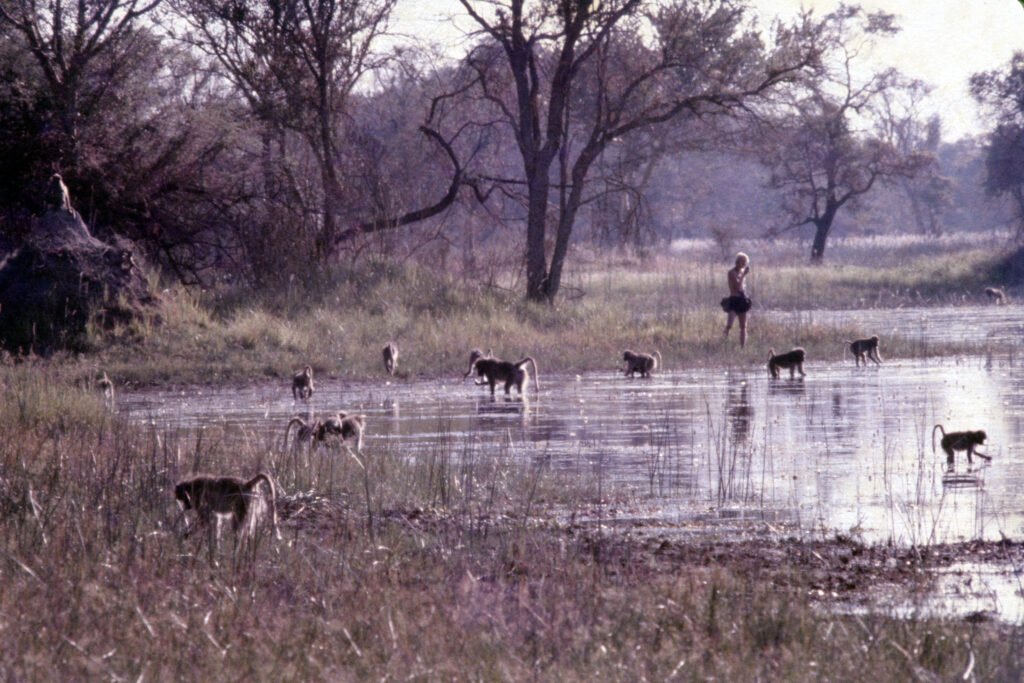
Here I am collecting feeding data on Camp Troop baboons foraging in a shallow floodplain (Photo by Van Davis).
The work was tedious and monotonous. Often, I found myself more interested in spending the night beneath the trees where the baboons slept, hoping to document leopard attacks.2 The nutrition study itself was proving less fruitful than we had hoped, and by 1979 my dissertation project was in trouble.
To strengthen the study, Bill brought in Derek Melton, a postdoctoral researcher, and his wife Carol to collect blood samples and physiological measurements that could be correlated with age, dominance status, and female reproductive state.3 Their arrival injected new energy into the camp, both scientifically and socially.
Derek and Carol somehow transformed our isolated bush camp into a functioning field laboratory.4 Bill also brought in Dr. Murray Fowler, a renowned veterinarian from U.C. Davis, who arrived with everything needed to dart and anesthetize large numbers of baboons. During a week-long crash course, he trained us to use a simple yet ingenious blow-dart system: a slender four-foot aluminum pipe and syringe darts loaded with carefully measured doses of ketamine or phencyclidine.5
Betraying the Baboons’ Trust
The darting plan was, in a sense, insidious.
For two years Steve and I had worked patiently to gain the baboons’ trust. The animals had gradually learned that humans on foot posed no danger. Now we were preparing to exploit that trust. The baboons had no idea what was coming.
The first darting went without a hitch. Derek casually positioned himself five yards behind an adult male sitting on the ground with his back turned. He inserted the dart into the blowpipe, raised it to his mouth, and blew.
The dart struck the baboon in the lower back and remained lodged in the muscle. The startled animal ran about twenty yards, stopped, sat quietly for a moment, and then slowly collapsed as the drug took effect (photo).
Blood samples were collected, dental impressions made, and body measurements recorded. An hour or so later the baboon was walking again, though groggy, and soon rejoined his troop wearing brightly colored plastic ear tags.6
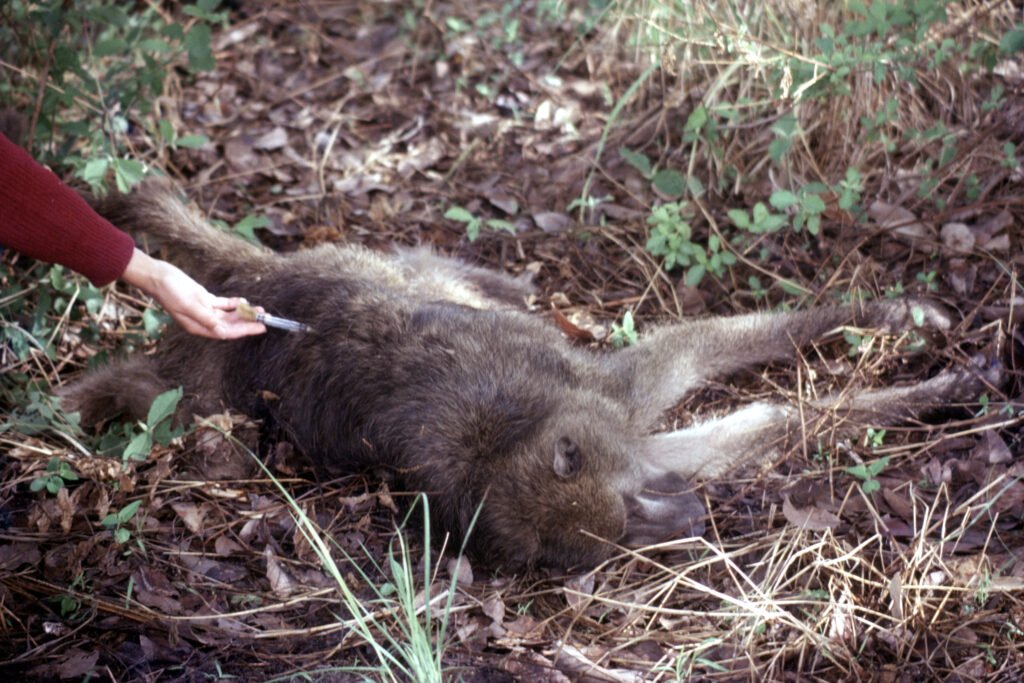
Syringe-dart in the lower back of a recently anesthetized adult male.
At first the process seemed manageable, but complications soon emerged. One darted baboon climbed high into a tree before the ketamine fully took effect and fell heavily to the ground like a limp rag doll. Fortunately, the deep sand cushioned the fall.
After that, when a darted animal climbed a tree, four of us sometimes stood below holding a blanket stretched tight like a fire net, hoping to catch it before it hit the ground. It was quite unnerving, but during the initial dartings the baboons suffered no apparent injuries.
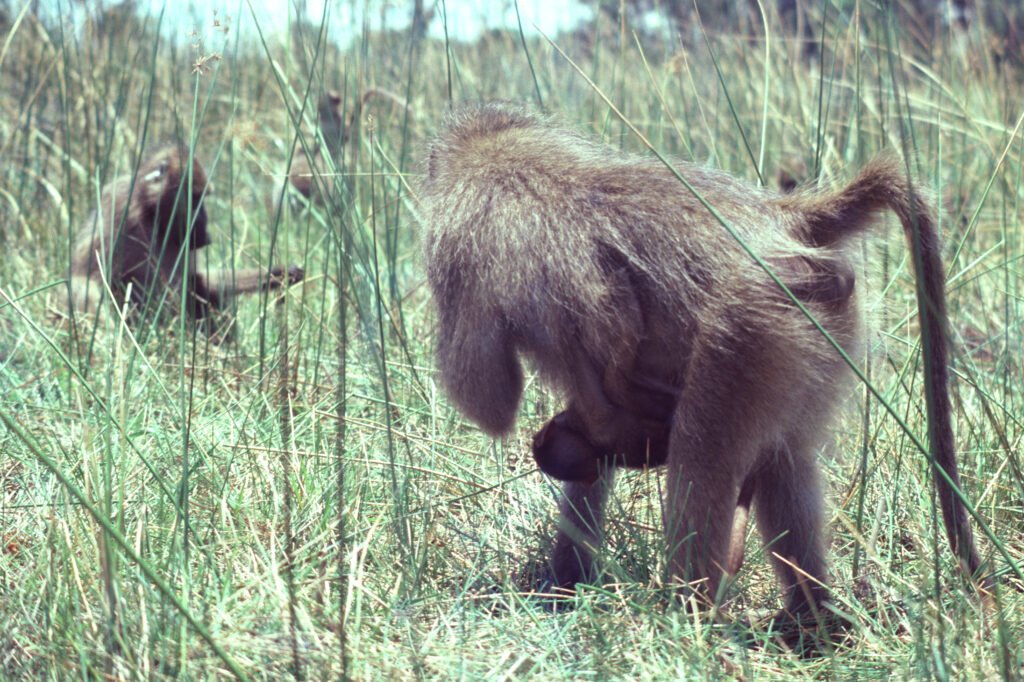
We even successfully darted a mother carrying a small infant (photo), which calmly clung to her throughout the procedure.
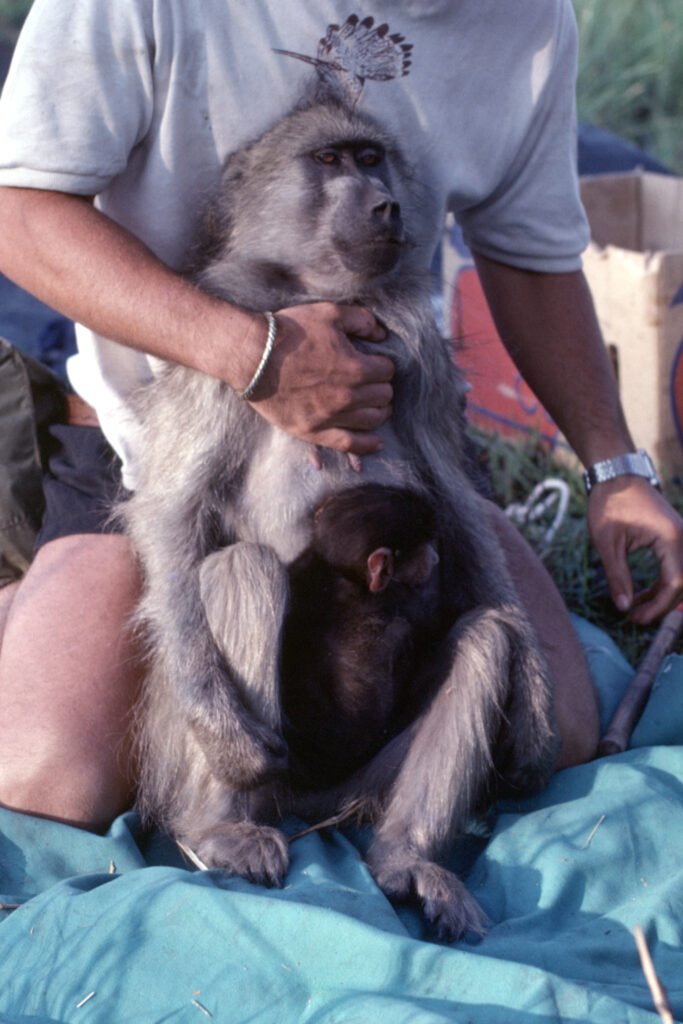
Adult female CMN and her infant CMX.
Then disaster struck.
The Death of Muni’s Infant
On September 1, 1979, we darted a female named Muni (CMU), who carried a four-day-old infant. Before the drug took effect, she disappeared into dense vegetation and we lost sight of her.
Nine minutes later we heard loud calls and the sounds of two males fighting.
We found Muni unconscious in tall grass. Her infant was gone.
Moments later, to our horror, we spotted the adult male Bamm-Bamm (CBB) sitting in a nearby tree, biting into the infant’s lifeless body (photo).
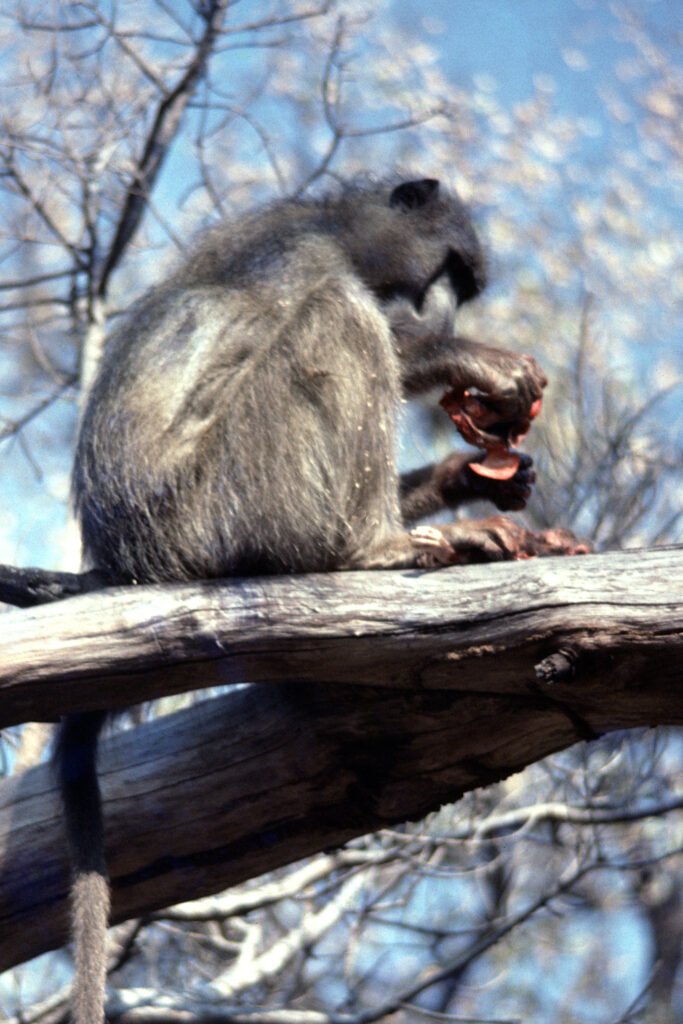
(Photo by Lisbeth Nygaard Nilsson)
The possibility of infanticide in baboons had not been on our radar. Such behavior was best known in monkeys like langurs that lived in single-male groups. Reports from baboons existed, but they were rare and anecdotal.7
The evolutionary explanation was disturbing but straightforward. When a new male entered a troop and attained high dominance, he could increase his own reproductive success by killing unweaned infants fathered by other males. The death of the infant caused the mother to return to fertility sooner, allowing the new male an opportunity to sire his own offspring more quickly.
The idea ran counter to older notions that animals behaved “for the good of the species.” Yet by the late 1970s, evidence supporting infanticide as a male reproductive strategy was steadily accumulating across many mammals.8
After the death of Muni’s infant, Bill immediately halted all darting of mothers carrying infants. We hoped the attack had been an isolated incident caused by our interference, but we were not willing to risk another such tragedy.
Only nine days later, Bill and Steve observed another attack near camp at dusk. An adult male bit a nine-month-old infant in the head. The infant was found dead the following morning with a puncture wound below the ear.
Something far more important was happening within chacma baboon society than we had understood.
Diminishing Returns
By then our darting operations were also becoming more difficult. The baboons had grown wary of Derek and no longer allowed him to approach closely. Steve and I eventually took over all of the darting ourselves.
Over the next few months, each of us darted roughly twenty-five baboons.
For two years these animals had allowed us to observe their lives at close range. We knew them individually. We recognized personalities, family relationships, and dominance hierarchies. Now we were betraying the trust we had carefully built. And they knew it.
It was painful. Some nights I lay awake knowing that the next day would be my turn with the blowpipe.
In the 1970s, darting wild animals was widely accepted in field biology and in wildlife documentaries. Today, new technologies have largely replaced such methods. Non-invasive hormonal and DNA analysis, AI-assisted remote monitoring, and other techniques have transformed the field. Darting wild baboons to gather physiological data would now be much harder to justify.
The Observation on White Island
Thirteen days after the death of Muni’s infant, I was following our other study troop on White Island. It was a quiet afternoon, the baboons spread peacefully through open grassland dotted with acacia trees.
At one point I focused on a female named Farah (WFR) and her seven-week-old daughter, Fanni (WFI). Nearby sat Captain Kirk (WCK), the troop’s second-ranking male and the only male I had seen consorting with Farah during the period when Fanni had been conceived.9
Although irrelevant to my nutrition study, I was aware that Captain Kirk was probably Fanni’s father.
As the three rested together, another male approached through the grass. It was Norbert10 (WNR), the new alpha male who had immigrated into the troop roughly two and a half months earlier. Since baboon gestation lasts about six months, Norbert could not have fathered Fanni.
As Norbert drew closer, young Fanni climbed onto Captain Kirk’s lap. He lifted the infant and stood facing Norbert in a stiff, defensive posture. Fanni clung upside-down to Captain Kirk’s belly while both males stared at each other.
Although young infants are usually carried almost exclusively by their mothers, Farah showed no sign of alarm as Captain Kirk held her daughter.
In another encounter several days later, Fanni clings to Captain Kirk’s chest while watching Norbert forage nearby. 
At the time, this type of interaction was known as “agonistic buffering.”11 In several baboon and macaque species, lower-ranking males were known to hold infants during tense encounters with more dominant opponents. The standard explanation was that the infant acted as a kind of social shield, reducing the chance of aggression toward the male holding the infant.
I had occasionally seen similar interactions in our baboons, but I had paid them little attention.
Then the meaning of these interactions hit me all at once.
Captain Kirk was not using Fanni as a buffer. He was protecting Fanni.
A New Understanding
Sitting there on White Island, with the recent infanticides fresh in my mind, I realized that I had spent two years documenting baboon diets while remaining oblivious to the social drama taking place around me.
The patterns suddenly became obvious.
Mothers often stayed close to likely fathers and appeared calm and relaxed in their presence, as did their infants. In striking contrast, mothers — but not other adult females — showed clear anxiety around newly arrived males, especially by raising their tails, avoiding them, or sometimes screaming as they approached.
During interactions between males involving an infant, the male holding the infant had almost always been present — and often had been observed mating with the mother — when the infant was conceived. The opposing male, by contrast, was typically a recent immigrant who could not possibly have been the father.12
And, as we had just discovered, such immigrant males could pose a mortal threat to infants.
I sat watching Captain Kirk, Farah, and Fanni for more than an hour with a growing realization that I had stumbled onto something important. Norbert wandered away and the tension eased. Fanni resumed playing clumsily near Captain Kirk, often within inches of him.
During the long trip back to camp, I could barely contain my excitement about the implications of what I had just seen. Before I even reached camp, I knew I wanted to abandon my dissertation on baboon diets and focus instead on relationships between adult males, mothers, and infants.
When I told Bill what I had seen, he was skeptical at first. The next morning we drove out together to White Island and followed Norbert for several hours. Whenever he was in the vicinity of mothers with young infants, they reacted nervously, especially by raising their tails when he neared. And they often maintained proximity to resident males like Captain Kirk.
By the end of the day, Bill had seen enough. To my delight, he agreed to let me change my dissertation topic.
A Foregone Conclusion
For the next nine months I focused almost entirely on interactions between mothers, infants, and adult males. I documented which males mothers associated with, how females reacted to immigrant males, and how male-infant interactions varied depending on probable paternity.
Unlike the feeding study, this was exhilarating work. Although researchers are supposed to test hypotheses rather than fall in love with them, the conclusion now seemed difficult to escape.
In all my years watching primates, I had never seen behavior that seemed so lawful and consistent. The reactions of mothers toward recently immigrated high-ranking males were especially striking. Mothers with young infants treated these newcomers very differently from resident males, responding with clear signs of tension and distrust.13 And this was true in both of our study troops.14
The findings were eventually published in the prestigious journal Science15 (photo).
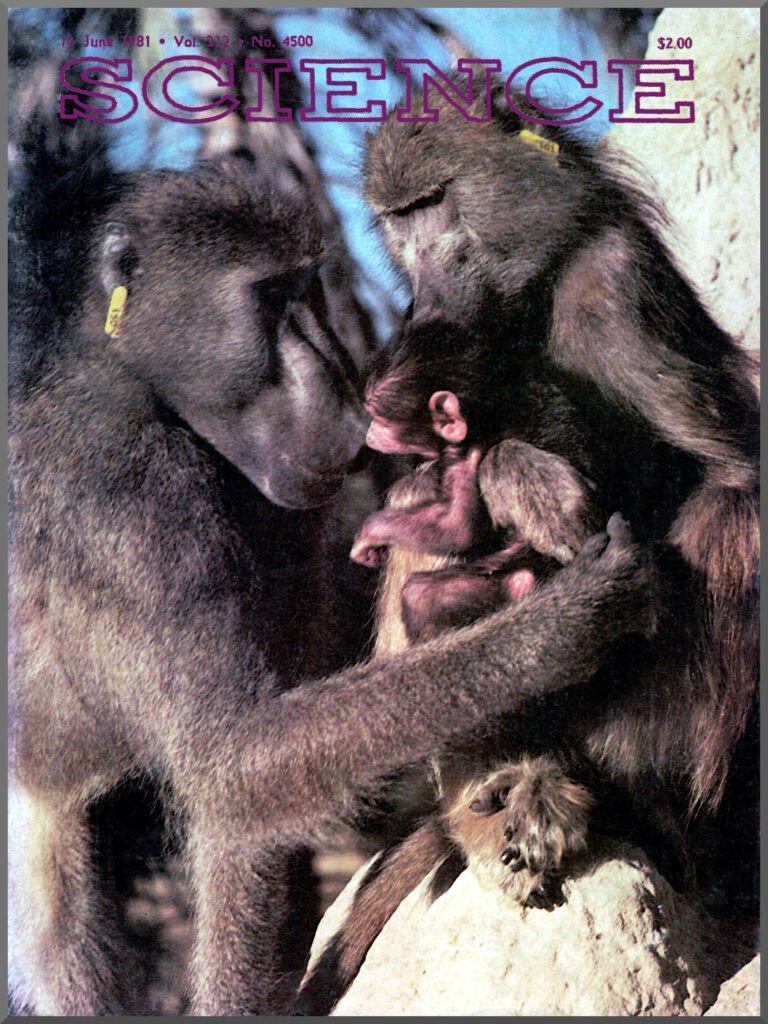
Bill took this incredible photo of a resident adult male cradling an infant being held by its mother. The photo appeared on the cover of Science (June 12, 1981).
The darting project had begun as an attempt to rescue a struggling nutrition study. It inadvertently exposed a hidden and deeply unsettling feature of chacma baboon society. By temporarily disabling a mother’s ability to protect her infant, we unintentionally revealed a danger that normally remained concealed by the checks and balances of baboon life.
It was a discovery born from an unfortunate accident — one that permanently changed both my research and my understanding of these remarkable animals.
- Bielert, C., & Busse, C. (1983). Influences of ovarian hormones on the food intake and feeding of captive and wild female chacma baboons (Papio ursinus). Physiology & Behavior, 30(1), 103-111.
↩︎ - Busse, C. (1980). Leopard and lion predation upon chacma baboons living in the Moremi Wildlife Reserve. Botswana Notes & Records, 12(1), 15-21.
↩︎ - Melton, DA & Melton, C. L. (1982). Blood parameters of the wild chacma baboon, Papio ursinus. African Zoology, 17(2), 85-90.
↩︎ - Melton, Derek A. & Melton, C. (1981). Immobilisation and blood analyses of baboons (Papio ursinus) in the Okavango Swamp. Botswana Notes & Records, 13(1), 119-122.
↩︎ - Melton, D. A. (1980). Baboon (Papio ursinus) capture using a blow-dart system. South African Journal of Wildlife Research, 10(2), 67-70.
↩︎ - Steve and I already recognized the individuals in both troops, so the ear-tags were of little use to us. They undoubtedly proved more useful for recently arrived students, although about half of the tags had fallen out within a year.
↩︎ - Collins, D. A., Busse, C. D., & Goodall, J. (1984). Infanticide in two populations of savanna baboons. In: Hausfater, G., & Hrdy, S. B. (1984). Infanticide: comparative and evolutionary perspectives. pp. 193–215, New York: Aldine.
↩︎ - Hausfater, G., & Hrdy, S. B. (1984). Infanticide: comparative and evolutionary perspectives. New York: Aldine.
↩︎ - Hendrickx, A. G., & Kraemer, D. C. (1969). Observations on the menstrual cycle, optimal mating time and pre-implantation embryos of the baboon, Papio anubis and Papio cynocephalus. Journal of Reproduction and Fertility, Supplement, 6, 119–128.
Hendrickx and Kraemer found that female baboons are most likely to conceive during the final few days before their sexual swelling begins to detumesce. Researchers could estimate probable conception windows and therefore identify likely fathers based on which males consorted with or mated with the female during those critical days.
↩︎ - Norbert’s full name was Norbert the Narc.
↩︎ - Deag, J. M., & Crook, J. H. (1971). Social behaviour and ‘agonistic buffering’in the wild Barbary macaque Macaca sylvana L. Folia primatologica, 15(3-4), 183-200.
↩︎ - Busse, C. (1984). Triadic interactions among male and infant chacma baboons. In Taub, D. M. (1984). Primate Paternalism. pp 186-212. New York: Van Nostrand Reinhold.
↩︎ - Busse, C. D. (1984). Tail raising by baboon mothers toward immigrant males. American Journal of Physical Anthropology, 64(3), 255-262.
↩︎ - The home ranges of our two study troops, White Island (W) and Camp (C), barely overlapped. They rarely encountered each other, and no males transferred between the troops during the study period.
↩︎ - Busse, C., & Hamilton III, W. J. (1981). Infant carrying by male chacma baboons. Science, 212(4500), 1281-1283.
↩︎